
← All marine life
Gentoo Penguin
Species IUCN · Least Concern (LC)

Gentoo Penguin

Pygoscelis papua, (Forster, 1781)

marine

About Gentoo Penguin

The gentoo penguin (Pygoscelis papua) is a penguin species (and possibly species complex) in the genus Pygoscelis, most closely related to the Adélie penguin (P. adeliae) and the chinstrap penguin (P. antarcticus). The earliest scientific description was made in 1781 by Johann Reinhold Forster with a type locality in the Falkland Islands. The species calls in a variety of ways, but the most frequently heard is a loud, trumpeting call, emitted with the head thrown back.

Appearance

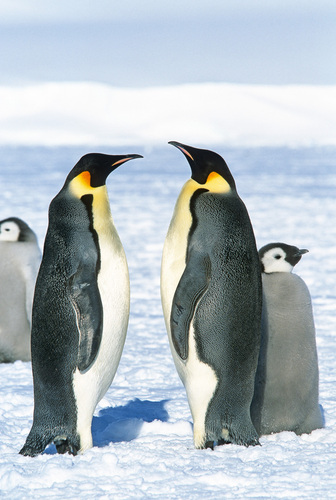
The gentoo penguin is easily recognised by the broad, white stripe extending like a bonnet across the top of its head and its bright orange-red bill. It has pale whitish-pink, webbed feet and a relatively long tail – the most prominent tail of all penguin species. Chicks have grey backs with white fronts. As the gentoo penguin waddles along on land, its tail sticks out behind, sweeping from side to side, hence the scientific name Pygoscelis, which means "rump-tailed".
Diet

Gentoos mainly live on fish, crustaceans such as krill and shrimp, and cephalopods. In February and March, crustaceans make up about 10% of the diet, while from March to June, it is about 75%. From June to October, grey rockcod (Lepidonotothen squamifrons) make up 90% of their diet. Cephalopods make up only 10% of the diet throughout the year.

Gentoos are opportunistic feeders, and around the Falklands are known to take roughly equal proportions of fish (Patagonotothen sp., Thysanopsetta naresi, Micromesistius australis), squat lobsters (Munida gregaria) and squid (Loligo gahi, Gonatus antarcticus, Moroteuthis ingens). Other prey include Channichthys rhinoceratus and octopuses.

Reproduction

The breeding colonies of gentoo penguins are located on ice-free surfaces. Settlements can be located directly on the shoreline or considerably inland. They prefer shallow coastal areas and often nest between tufts of grass. In South Georgia, for example, breeding colonies are 2 km (1.2 mi) inland. In colonies farther inland, where the penguins nest in grassy areas, they shift their location slightly each year because the grass becomes trampled over time.

Humans & conservation

The population of Pygoscelis papua in the maritime Antarctic is rapidly increasing. Due to regional climate change, they colonise previously inaccessible territories to the south. As of 2019, the IUCN Red List lists the gentoo as least concerned with a stable population trend. However, rapid declines in some key areas are believed to be driving a moderate overall decline in the species population. Examples include Bird Island, South Georgia, where the population has fallen by two-thirds over 25 years. Many threats to this species, including pollution, hunting, fishing, and human recreational activities, continue to affect them.

Part of

Where to see it

No dive sites list Gentoo Penguin yet. Explore the map to find sites near you.