
← All marine life
Galapagos Sea Lion
Species IUCN · Endangered (EN)

Galapagos Sea Lion

Zalophus wollebaeki, Sivertsen, 1953

marine

About Galapagos Sea Lion

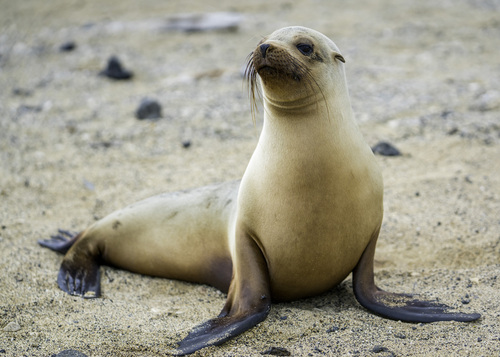
The Galápagos sea lion (Zalophus wollebaeki) is a species of sea lion that lives and breeds on the Galápagos Islands and, in smaller numbers, on Isla de la Plata (Ecuador). They are the smallest sea lion species.

Appearance

Slightly smaller than their Californian congener, Galápagos sea lions range from 1.5 to 2.5 m (4.9 to 8.2 ft) in length and weigh between 50 and 400 kg (110 and 880 lb), with the males averaging larger than females. Sexual dimorphism plays a small role in the physical characteristics and size of Galápagos sea lions, as males also tend to have a thicker, more robust neck, chest, and shoulders in comparison to their slender abdomen, whereas females have a longer, more slender neck and thick torso. The male's sagittal crest enlarges when he reaches sexual maturity, forming a small, characteristic bump-like projection on his forehead. Adult females and juveniles lack this trait and have a nearly flat head and little or no forehead. Galápagos sea lions, compared to California sea lions, have a slightly smaller sagittal crest and a shorter muzzle.
Habitat

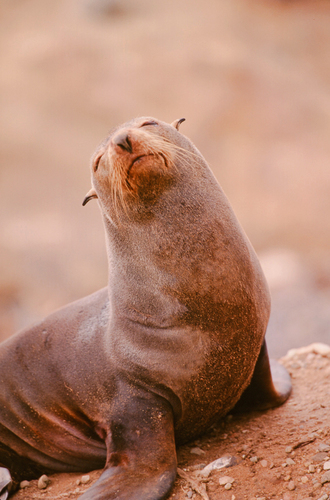
Galápagos sea lions can be found on all of the main islands of the Galápagos archipelago, and on a number of smaller islands in the area. Less than a quarter of them reside on San Cristobal Island. They have also colonized Isla de la Plata, just offshore mainland Ecuador, and can be spotted from the Ecuadorian coast north to Isla Gorgona in Colombia. Records have also been made of sightings on Isla del Coco, which is about 500 km (310 mi) southwest of Costa Rica. The population on Isla del Coco is considered vagrant.

Diet

While information on the diet of Galapagos sea lions is limited, it is known that they are carnivores that feed mostly on sardines. They also eat other marine life like crustaceans, squid, fish (sardines and myctophids/lanternfish), and octopus, which classifies them as piscivores. Galápagos sea lions sometimes travel 10–15 km (6.2–9.3 mi) from the coast over a span of days to hunt. This is when they come into contact with their main predators: sharks and killer whales. Injuries and scars from attacks are often visible. During El Niño events, occurring when the water temperature pattern changes in the Pacific, sardine populations either die or migrate, and sea lions dive deeper to feed on lantern fish. The reduction in food availability during El Niño leads to sea lion population declines.

Behaviour

Galápagos sea lions are especially vulnerable to human activity. Their inquisitive and social nature makes them more likely to approach areas inhabited by humans, and thus come into contact with human waste, fishing nets, and hooks. They occupy many different shoreline types, from steep, rocky cliff sides to low-lying sandy beaches. To avoid overheating during the day, sea lions will take refuge from the sun under vegetation, rocks, and cliffs.

Not only are sea lions social, they are also quite vocal. Adult males often bark in long, loud and distinctive repeated sequences. Females and juveniles do not produce this repetitive bark, but both sexes of younger pups will growl. From birth, a mother sea lion recognizes her pup's distinct bark and can pinpoint it from a crowd of 30 or more barking sea lions.

Reproduction

The age of maturity for Galápagos sea lions is about 4–5 years. The life span is estimated to be 15–24 years. Breeding takes place from May through January. Because of this prolonged breeding season and the extensive care required by the pups from their mother, there are dependent pups in the colonies year round. Each cow in the harem has a single pup born a year after conception. After about a week of continuous attention from birth, the female returns to the ocean and begins to forage, and just a week after that, the pup will follow her and begin to develop its swimming skills. When the pup is two to three weeks old, the cow will mate again. The mothers will take the young pups with them into the water while nursing until around the 11th month, when the pups are weaned from their mother's milk and begin developing their own hunting skills.

Humans & conservation

The majority of the Galápagos population is protected, as the islands are a part of an Ecuadorian national park surrounded by a marine resources reserve. Although the Galápagos Islands are a popular tourist destination, strict rules exist to protect all wildlife from disturbance. Fluctuating between 20,000 and 50,000 sea lions, the population does have a few threats. During el Niño events, the population tends to decrease as ocean temperatures warm and cold-adapted marine life on which the sea lions depend declines, which lead to die-offs or cessation of reproduction. Sharks and killer whales are the main predators of the sea lion. Although adult sea lions have less to worry about, pups are easy targets.

Part of

Where to see it

No dive sites list Galapagos Sea Lion yet. Explore the map to find sites near you.