
← All marine life
Galápagos Penguin
Species IUCN · Endangered (EN)

Galápagos Penguin

Spheniscus mendiculus, Sundevall, 1871

marine

About Galápagos Penguin

The Galápagos penguin (Spheniscus mendiculus) is a penguin endemic to the Galápagos Islands of Ecuador. It is the only penguin found north of the equator. Most inhabit Fernandina Island and the west coast of Isabela Island. The cool waters of the Humboldt and Cromwell Currents allow it to survive despite the tropical latitude. The Galápagos penguin is one of the banded penguins, the other species of which live mostly on the coasts of Africa and mainland South America. Due to their warm environment, Galápagos penguins have developed techniques to stay cool. The feathers on their back, flippers, and head are black, and they have a white belly and a stripe looping from their eyes down to their neck and chin. Each penguin keeps only one mate, and breeds year-round. Because there are no soft areas to nest, their nests are typically in caves and crevices which also provide protection against predators and the harsh environment. The Galápagos penguin has a lifespan of 20 years, but due to predation, life expectancy in the wild could be significantly reduced. They have been critically impacted to the point of endangerment by climate change and pollution caused by plastic waste due to tourism and urbanization.

Appearance

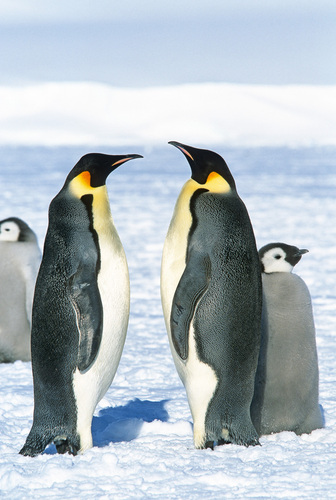
The average Galápagos penguin is 48–50 centimetres (19–20 in) tall and weighs around 2–4 kilograms (4.4–8.8 lb). It is the second-smallest species of penguin, after the little penguin. Females are usually smaller than males. Galápagos penguins have a black head with a white border running from behind the eye, around the black ear coverts and chin, to join on the throat. The top of the beaks are black and fade into pink on the bottom. They have two black bands across the breast that connect to the back, the lower band extending down the flanks to the thigh. Juveniles differ in having a wholly dark head, grayer on side and chin, and no breast band.
Habitat

Approximately 95% of the Galapagos penguin population occurs on Fernandina Island and the western coast of Isabela Island, in the western part of the Galapagos archipelago. These islands are influenced by the Cromwell Current, which brings cold, nutrient-rich water to the surface and supports the marine food web on which the penguins depend. The remaining population is distributed among smaller breeding sites elsewhere in the archipelago. The species' distribution is closely associated with the availability of suitable coastal habitat and food, both of which can vary with oceanographic conditions.

Behaviour

Galápagos penguins are confined to the Galápagos Islands, foraging in the cool Cromwell Current during the day and returning to the land at night. They eat small schooling fish, mainly mullet, sardines, pilchards and anchovies, and sometimes crustaceans. They play a role in regulating the populations of the marine species they consume. At the same time, the adult Galápagos penguins are a food source for other predators such as sharks and whales. They normally range only a few kilometers from their breeding sites, and depend on the cold, nutrient-rich currents to bring them food.

Reproduction

Galápagos penguins are a monogamous species, each pair mating for life. There are around 1,000 breeding pairs of Galápagos penguins in the world, and breeding depends on certain climate events. During El Niño, birds may not breed due to these climate conditions. After completing courtship, with rituals including bill dueling, flipper patting, and mutual preening, the pair will build and maintain a nest. Most nests are seen between May and July because both quantity of food and climate conditions are typically most optimal. The nests are made within 50 metres (160 ft) of the water on the shore. Adults stay near the breeding area during the year with their mate. It lays one or two eggs in places such as caves and crevices, protected from direct sunlight, which can cause the eggs to overheat.

Humans & conservation

The Galápagos penguin is a particularly vulnerable bird species due to its limited range on the Galápagos Islands. With a population of only about 1800, it remains on the endangered species list, and its population will likely fluctuate strongly in response to anthropogenic changes in the region. The primary danger to the Galápagos penguin is the climate phenomena known as El Niño. In 1982–83 and 1997–98, two super El Niño events resulted in Galápagos penguin population declines of 77% and 65%, respectively. Additionally, the years 1965–66, 1968–69, 1972–73, 1976, 1986–87, 1991–92 and 1993 all had relatively weak El Niño events which were associated with slow population recovery. Conversely, during La Niña events when sea surface temperatures are lower than normal and the climate patterns shift, Galápagos penguin populations begin to recover.

Part of

Where to see it

No dive sites list Galápagos Penguin yet. Explore the map to find sites near you.