
← All marine life
Galápagos Fur Seal
Species IUCN · Endangered (EN)

Galápagos Fur Seal

Arctocephalus galapagoensis, Heller, 1904

marine

About Galápagos Fur Seal

The Galápagos fur seal (Arctocephalus galapagoensis) is one of eight seals in the genus Arctocephalus. It is the smallest of all eared seals. It is endemic to the Galápagos Islands in the eastern Pacific. The total estimated population as of 1970 was said to be about 30,000, although the population has been said to be on the decline since the 1980s due to environmental factors such as pollution, disease, invasive species, and their limited territory. Due to the population having been historically vulnerable to hunting, the Galápagos fur seal has been protected by the Ecuadorian government since 1934.

Appearance

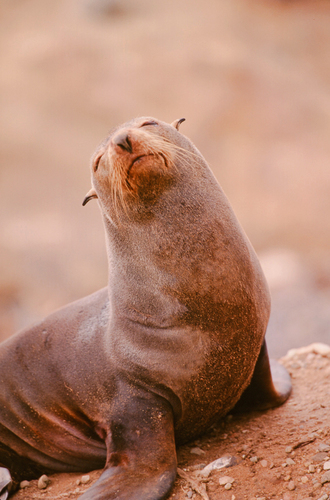
Galápagos fur seals are the smallest otariids. They are born with a black natal coat that they molt to reveal a lighter brown coat before becoming adults. Of the otariids, Galápagos fur seals display the least amount of sexual dimorphism. The males are up to two times heavier than the females and 1–1.3 times longer. Males grow to be 1.5 m (5 feet) on average and weigh about 64 kg (140 lb). Females grow to be 1.25 m (4 ft 1 in) on average and weigh 27 kg (60 lb). They also have large eyes which allow them to hunt at night. The Galápagos fur seals look very similar to the Galápagos sea lions.
Habitat

The Galápagos fur seal is endemic to the Galapagos Islands in Ecuador, South America. It is present on nearly all the islands of the Galapagos. They are typically found close to the coastline where there are rock ledges and crevices that they can find shade in, in such a warm climate. It is classified as a non-migrant species. Females that are lactating do not travel long distances and tend to stay within the colony and only have moderately brief outings when they do venture out. However, recent research has documented the presence of Galápagos fur seals in Mexico and Guatemala.

Diet

The Galápagos fur seal feeds primarily on fish, squid and shellfish. They feed relatively close to shore and near the surface, but have been seen at depths of 169 m (554 ft). They primarily feed at night because their prey is much easier to catch then. During normal years, food is relatively plentiful. However, during an El Niño year, there can be fierce competition for food, and many young pups die during these years. The adult seals feed themselves before their young and during particularly rough El Niño years, most of the young seal populations will die.

The Galápagos fur seal has virtually no constant predators. Occasionally, sharks and orcas have been seen feeding on the seals, but this is very rare. Sharks and orcas are the main predator of most other seal species, but their migration paths do not usually pass the Galápagos.

Reproduction

Galápagos fur seals live in large colonies on the rocky beaches of the Galápagos Islands. These colonies are then divided into territories by the male seals during breeding season, which is mid-August to mid-November, with a peak in late September and early October. Each successful reproductive female will choose a territory on the beach to pup on.

Humans & conservation

The Galápagos Islands are heavily trafficked by tourists. However, tourism is well regulated and restricted by the Ecuadorian government. Collisions with boats which frequent the waters near the islands could also be fatal to the Galapagos fur seals. Historically, the Galápagos fur seal has also been threatened by hunting and invasive species. Whalers and sealers used to hunt the seals for their fur. The threat of hunting has been removed since the declaration of the Galápagos islands as a national park and the protection of the species under law.

Part of

Where to see it

No dive sites list Galápagos Fur Seal yet. Explore the map to find sites near you.