
← All marine life
Feathertail Stingray
Species IUCN · Near Threatened (NT)

Feathertail Stingray

Pastinachus sephen, (Forsskål, 1775)

marinebrackishfreshwater

About Feathertail Stingray

The cowtail stingray (Pastinachus sephen) is a species of stingray in the family Dasyatidae, widespread in the Indo-Pacific region and occasionally entering freshwater habitats. Other common names include banana-tail ray, drab stingray, fantail ray, feathertail stingray, and frill tailed sting ray. This species is sometimes placed in the genus Dasyatis or Hypolophus (an obsolete synonym of Pastinachus). The most distinctive characteristic of the cowtail stingray is the large, flag-like ventral fold on its tail, which is especially prominent when the ray is swimming. This species is targeted by commercial fisheries as a source of high-quality shagreen, a type of leather, and its populations are now under threat from heavy exploitation.

Appearance

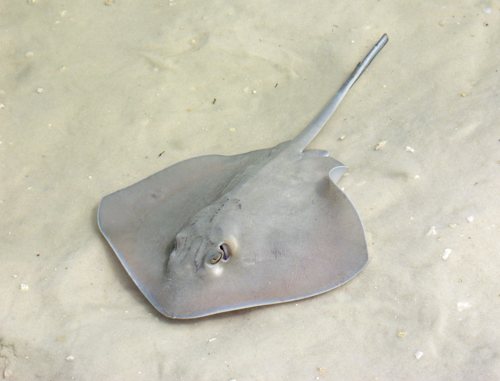
The pectoral fin disk of the cowtail stingray is very thick, with almost straight anterior margins and rounded apices, and measuring 1.1-1.3 times as long as wide. The snout is broadly rounded and blunt. The eyes are very small and widely spaced. The mouth is narrow, with 20 rows of distinctive hexagonal, high-crowned teeth in each jaw and five papillae on the mouth floor. The tail is broad-based, with a filamentous tip and a single venomous spine located well backwards of the pelvic fins. There is no upper tail fold; the high ventral tail fold measures 2-3 times the height of the tail but does not reach the tip.
Habitat

The cowtail stingray has a widespread distribution in the tropical waters of the Indo-Pacific, from South Africa and the Red Sea to Japan and Australia, including Melanesia and Micronesia. They are amphidromous and known to enter estuaries and rivers. This species is the most commonly reported stingray from fresh water in Southeast Asia, and there is a record from the Ganges River some 2,200 km (1,400 mi) from the sea. They are usually found on sandy bottoms in coastal waters and on coral reefs to a depth of 60 meters (200 feet).

Behaviour

Cowtail stingrays are solitary foragers that feed on bony fishes (including leiognathids, Nemipterus, and soles), crustaceans, polychaete worms, sipunculids, and molluscs. The cowtail stingray is in turn preyed upon by various species of hammerhead and requiem sharks, as well as by the bottlenose dolphin (Tursiops aduncus). When threatened, they consistently flee at a 45° angle away from the predator, a trajectory that allows them to maximize the distance covered while still keeping the predator within their field of vision.

Humans & conservation

The serrated spine of the cowtail stingray is potentially dangerous, and this species is regarded as particularly dangerous to handle as its long tail is capable of reaching over its back to strike someone gripping it from the front. Small to moderate numbers of cowtail stingrays are caught as bycatch in trawls and marketed for meat throughout their range, and their tough skin is used to polish wood. This species is also the primary source of shagreen or galuchat, a type of leather, for which it has been valued since ancient times due to the large size and regular arrangement of its dorsal tubercles (called "pearls" in the trade from their nacreous appearance after being rubbed down, hence the old name "pearled ray").

Part of

Where to see it

No dive sites list Feathertail Stingray yet. Explore the map to find sites near you.