
← All marine life
Eurasian Otter
Species IUCN · Near Threatened (NT)

Eurasian Otter

Lutra lutra, (Linnaeus, 1758)

marinefreshwater

About Eurasian Otter

The Eurasian otter (Lutra lutra), also known as the European otter, Eurasian river otter, European river otter, common otter, and Old World otter, is a semiaquatic mammal native to Eurasia and the Maghreb. It is the most widely distributed member of the otter subfamily (Lutrinae) of the weasel family (Mustelidae) and is found in the waterways and on the coasts of Europe, much of Asia, and parts of North Africa. The Eurasian otter eats mainly fish, and is strongly territorial. It is endangered in some parts of its range, but is recovering in others.

Appearance

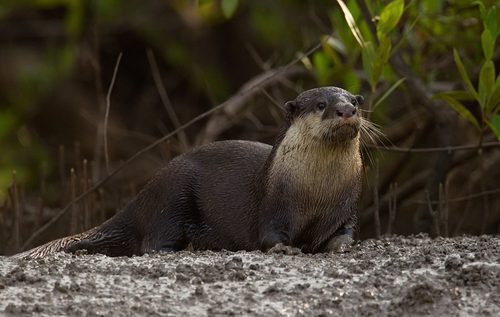
The Eurasian otter is a typical member of the otter subfamily. With brown fur on their backs and cream-coloured fur on their bellies, these long, slender creatures are well-equipped for their aquatic lifestyle. Their bones show osteosclerosis, which increases their density and reduces buoyancy. This otter differs from the North American river otter by its shorter neck, broader visage, the greater space between the ears and its longer tail. However, the Eurasian otter is the only otter in much of its range, so it is rarely confused for any other animal. Normally, this species is 57 to 95 cm (22.5 to 37.5 in) long, not counting a tail of 35–45 cm (14–17.5 in). The female is shorter than the male. The otter's average body weight is 7 to 12 kg (15 to 26 lb), although occasionally a large old male may reach up to 17 kg (37 lb).
Habitat

The Eurasian otter is the most widely distributed otter species. Its range includes Europe, North Africa and parts of Asia as far as the Palestine region. Though currently thought to be extinct in Liechtenstein and Switzerland, it is now common in Latvia, along the coast of Norway, in the western regions of Spain and Portugal and across Great Britain and Ireland. In Italy, it lives in the southern part of the peninsula.

It inhabits unpolluted bodies of fresh water such as lakes, streams, rivers, canals and ponds, as long as the food supply is adequate. In Andalusia, it uses artificial lakes on golf courses. It prefers the open areas of streams and also lives along the coast in salt water, but requires regular access to fresh water to clean its fur.

Behaviour

The Eurasian otter's diet consists primarily of fish, particularly in Mediterranean and temperate freshwater habitats where fish is most abundant.

During winter and in cooler climates, the Eurasian otter's diet includes worms, caterpillars, clams, crustaceans, insects, eggs, birds, and small mammals, including young European beavers, and amphibians.

The Eurasian otter is capable of overpowering prey that is significantly larger than itself, and it occasionally hunts large waterbirds such as adult greylag geese.

Reproduction

The Eurasian otter is strongly territorial and typically lives alone. The length of an individual's territory may vary in the range of 1 and 40 km (0.62–24.85 mi), with about 18 km (11 mi) being usual. The size of the territory depends on the availability of food and the width of suitable hunting grounds. It is shorter on coasts, where the available width is much greater, and longer on narrower rivers. The Eurasian otter uses its faeces, known as spraints, to mark its territory and prioritise the use of resources for other group members. The territories are only defended against members of the same sex, so the territories of males and females may overlap.

Humans & conservation

The Eurasian otter declined across its range in the second half of the 20th century primarily due to pollution from polychlorinated biphenyls and pesticides such as organochlorine. Other threats included habitat loss and hunting, both legal and illegal. Eurasian otter populations are now recovering in many parts of Europe. In the United Kingdom, for example, the number of sites with an otter presence increased by 55% between 1994 and 2002. In August, 2011, the Environment Agency announced that otters had returned to every county in England, having previously disappeared from all but the West Country and parts of Northern England.

Part of

Where to see it

No dive sites list Eurasian Otter yet. Explore the map to find sites near you.