
← All marine life
Estuary Stingray
Species IUCN · Vulnerable (VU)

Estuary Stingray

Hemitrygon fluviorum, (Ogilby, 1908)

marinebrackish

About Estuary Stingray

The estuary stingray (Hemitrygon fluviorum), also called the estuary stingaree or brown stingray, is a species of stingray in the family Dasyatidae. Endemic to eastern Australia, it typically inhabits shallow, mangrove-lined tidal rivers, estuaries, and bays in southern Queensland and New South Wales. This yellow-brown to olive ray grows to at least 93 cm (37 in) across. It has a diamond-shaped pectoral fin disc and a mostly smooth, whip-like tail bearing both dorsal and ventral fin folds. It can additionally be identified by its long, narrow nostrils and the row of thorns along the midline of its back.

While the estuary stingray has gained infamy for consuming farmed shellfish such as oysters, it mainly feeds on crustaceans and polychaete worms. It is aplacental viviparous, with the unborn young sustained to term by maternal histotroph ("uterine milk"). Once common, this species has apparently declined across much of its range, likely from a combination of habitat degradation, mortality from commercial and recreational fishing, and persecution by shellfish farmers. As a result, the International Union for Conservation of Nature (IUCN) has assessed it as Near Threatened.

Appearance

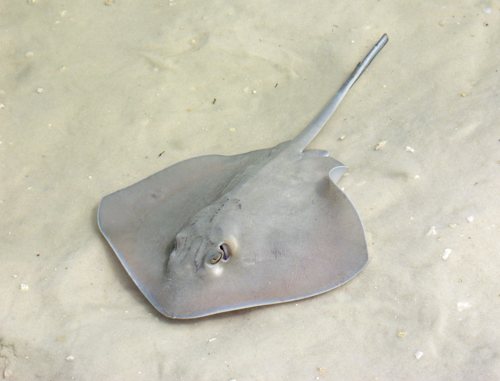
The estuary stingray has a diamond-shaped pectoral fin disc about as wide as long, with gently convex anterior margins and broadly rounded outer corners. The snout is wide and triangular, and tapers to a point. The small, widely spaced eyes are immediately followed by the spiracles. Between the long and narrow nostrils, there is a short and broad "skirt" of skin with a weakly fringed posterior margin. The small, bow-shaped mouth is surrounded by deep furrows and contains a row of five papillae across the floor, with the outermost pair tiny and set apart from the others. The teeth are small and arranged into pavement-like surfaces. There are five pairs of gill slits beneath the disc. The pelvic fins are relatively large.
Habitat

The range of the estuary stingray spans approximately 1,700 km (1,100 mi) along Australia's eastern coast, from Repulse Bay in Queensland to the Hacking River in New South Wales. It is most common in southern Queensland, including in Hervey Bay and Moreton Bay. This species was formerly suspected to have disappeared from Botany Bay and Port Jackson in the 1880s, but recent observations have shown this is not the case. Additional species records from the Cape York Peninsula, Northern Territory, New Guinea, and the South China Sea probably represent misidentifications of other stingrays, primarily the freshwater whipray (Himantura dalyensis) and the Merauke stingray (D. longicauda).

Behaviour

Despite its reputation for preying voraciously on oysters and other farmed shellfish, the estuary stingray's diet in fact consists mainly of crustaceans and polychaete worms. In Moreton Bay, an important prey species is the soldier crab (Mictyris longicarpus). This ray has been observed entering mudflats with the rising tide to forage for food. Known parasites of the estuary stingray include the tapeworm Shirleyrhynchus aetobatidis, the nematode Echinocephalus overstreeti and the monogeneans Heterocotyle chin, Empruthotrema dasyatidis and Neoentobdella cribbi.

Humans & conservation

Historical and anecdotal evidence strongly suggest that the once-abundant estuary stingray has declined substantially across its range. Although it is not commercially utilized, it faces a number of other threats. This species is captured incidentally by commercial bottom trawl and gillnet fisheries; bycatch mortality is exacerbated by the practice of "spiking", in which the ray's cranium is pierced with a metal bar or sharpened stick so as to move it. It is also readily caught, and often killed, by recreational anglers. Surveys in Moreton Bay have found fishing-related effects, such as embedded hooks and mutilated tails, in over 10% of the population. Habitat degradation is another major threat to the estuary stingray, especially given its habitat specificity.

Part of

Where to see it

No dive sites list Estuary Stingray yet. Explore the map to find sites near you.