
← All marine life
Species

Emperor Shrimp

Periclimenes imperator, (Kemp, 1922)

marine

About Emperor Shrimp

Zenopontonia rex, the emperor shrimp or imperial shrimp, is a species of shrimp in the family Palaemonidae. It is found in shallow water in the tropical Indo-Pacific region. It lives in association with a sea cucumber, a nudibranch or other large mollusc.

Appearance

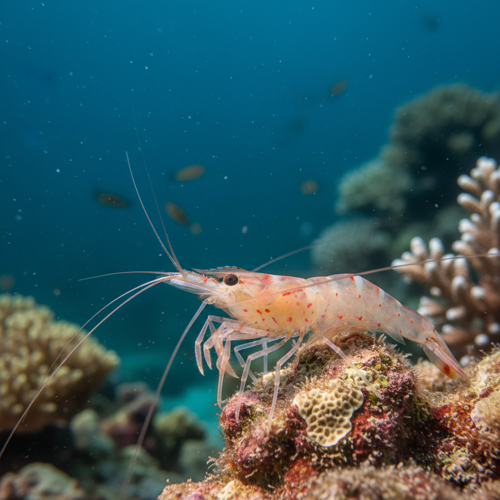
Zenopontonia rex is a robust shrimp growing to a length of about 3 cm (1.2 in), with females being rather larger and slightly less colourful. The antennae are modified into a series of plates that extend forwards from the head, and the rostrum has a crest-like extension. The cephalothorax bears a small spine on either side. The first two pairs of legs bear pincers with short sensory hairs. The basic colour of this shrimp is orange-yellow to orange-red, with purple antennal plates, claws and walking legs. However, during the day, white chromatophores in the skin expand and may cover much of the dorsal surface and tail fan; in other instances, the white colour appears as a median band, and the basic orange colour is revealed elsewhere.
Habitat

Zenopontonia rex is native to the tropical Indo-Pacific region. Its range extends from the Red Sea, Réunion and Mayotte to Hawaii and French Polynesia, and from southern Japan to New Caledonia and northern Australia. It is found at depths down to about 40 m (130 ft), always living in association with a large sea cucumber, a nudibranch or other large mollusc, perching on its back as its host moves around. It lives commensally on a number of hosts, including the sea slug Hexabranchus.

Behaviour

Zenopontonia rex lives as a commensal on sea cucumbers such as Bohadschia, Opheodesoma, Stichopus, Synapta maculata or Thelenota, or on nudibranchs and other large molluscs including Asteronotus, Ceratosoma, Chromodoris, Cypraea, Dendrodoris, Hexabranchus, Hypselodoris and Pleurobranchus; occasionally it has been observed living in association with a starfish such as Echinaster or Gomophia. There is often a pair of shrimps, or even three, on a single host, and then they usually have identical colouring. They keep to the dorsal surface or flanks, moving to the far side of the host if danger threatens. The shrimp feeds on detritus on the seabed, as well as cleaning the surface of its host and feeding on mucus and faeces.

Part of

Where to see it

No dive sites list Emperor Shrimp yet. Explore the map to find sites near you.