
← All marine life
Emperor Penguin
Species IUCN · Near Threatened (NT)

Emperor Penguin

Aptenodytes forsteri, Gray, 1844

marine

About Emperor Penguin

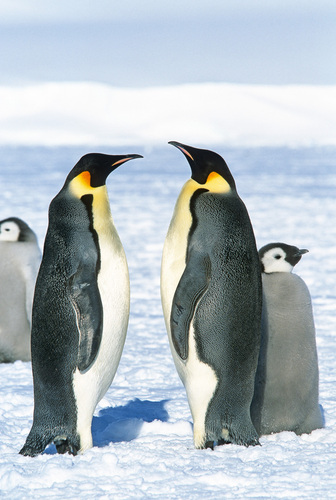
The emperor penguin (Aptenodytes forsteri) is the tallest and heaviest of all living penguin species and is endemic to Antarctica. The male and female are similar in plumage and size, reaching 100 cm (39 in) in length and weighing from 22 to 45 kg (49 to 99 lb). Feathers of the head and back are black and sharply delineated from the white belly, pale-yellow breast and bright-yellow ear patches.

Like all species of penguin, the emperor is flightless, with a streamlined body, and wings stiffened and flattened into flippers for a marine habitat. Its diet consists primarily of fish, but also includes crustaceans, such as krill, and cephalopods, such as squid. While hunting, the species can remain submerged around 20 minutes, diving to a depth of 535 m (1,755 ft). It has several adaptations to facilitate this, including an unusually structured haemoglobin to allow it to function at low oxygen levels, solid bones to reduce barotrauma, and the ability to reduce its metabolism and shut down non-essential organ functions.

Appearance

Adult emperor penguins are 110–120 cm (43–47 in) in length, averaging 115 cm (45 in) according to Stonehouse (1975). Due to the method of bird measurement that measures length between bill to tail, sometimes body length and standing height are confused, and some reported height even reaching 1.5 m (4 ft 11 in) tall. There are still more than a few papers mentioning that they reach a standing height of 1.2 m (3 ft 11 in) instead of body length. Although standing height of emperor penguin is rarely provided at scientific reports, Prévost (1961) recorded 86 wild individuals and measured maximum height of 1.08 m (3 ft 7 in). Friedman (1945) recorded measurements from 22 wild individuals and resulted height ranging 83–97 cm (33–38 in). Ksepka et al. (2012) measured standing height of 81–94 cm (32–37 in) according to 11 complete skins collected in American Museum of Natural History.
Habitat

The emperor penguin has a circumpolar distribution in the Antarctic almost exclusively between the 66° and 77° south latitudes. It almost always breeds on stable pack ice near the coast and up to 18 km (11 mi) offshore. Breeding colonies are usually in areas where ice cliffs and icebergs provide some protection from the wind. Three land colonies have been reported: one (now disappeared) on a shingle spit at the Dion Islands on the Antarctic Peninsula, one on a headland at Taylor Glacier in Victoria Land, and most recently one at Amundsen Bay. Since 2009, a number of colonies have been reported on shelf ice rather than sea ice, in some cases moving to the shelf in years when sea ice forms late. As of 2022, there were 66 known breeding colonies.

Diet

The emperor penguin's predators include birds and aquatic mammals. Southern giant petrels (Macronectes giganteus) are the predominant land predator of chicks, responsible for over one-third of chick deaths in some colonies; they also scavenge dead penguins. The south polar skua (Stercorarius maccormicki) mainly scavenges for dead chicks, as the live chicks are usually too large to be attacked by the time of its annual arrival in the colony. Occasionally, a parent may attempt to defend its chick from attack, although it may be more passive if the chick is weak or sickly.

Behaviour

The emperor penguin is a social animal in its nesting and its foraging behaviour; birds hunting together may coordinate their diving and surfacing. Individuals may be active day or night. A mature adult travels throughout most of the year between the breeding colony and ocean foraging areas; the species disperses into the oceans from January to March.

Reproduction

Although emperor penguins can breed at around three years of age, they generally do not begin breeding for another one to three years. The yearly reproductive cycle begins at the start of the Antarctic winter, in March and April, when all mature emperor penguins travel to colonial nesting areas, often walking 50 to 120 km (31 to 75 mi) inland from the edge of the pack ice. The start of travel appears to be triggered by decreasing day lengths; emperor penguins in captivity have been induced successfully into breeding by using artificial lighting systems mimicking seasonal Antarctic day lengths. The British Antarctic Survey used satellite imagery to find new emperor penguin breeding sites in Antarctica, a discovery that increased the estimated population of the emperor penguins by 5 to 10 percent to around 278,000 breeding pairs.

Humans & conservation

In 2012, the emperor penguin was downgraded from a species of least concern to near threatened by the IUCN. Along with nine other species of penguin, it is currently under consideration for inclusion under the US Endangered Species Act. The primary causes for an increased risk of species endangerment are declining food availability, due to the effects of climate change and industrial fisheries on the crustacean and fish populations. Other reasons for the species's placement on the Endangered Species Act's list include disease, habitat destruction, and disturbance at breeding colonies by humans. Of particular concern is the impact of tourism. One study concluded that emperor penguin chicks in a crèche become more apprehensive following a helicopter approach to 1,000 m (3,300 ft).

Part of

Where to see it

No dive sites list Emperor Penguin yet. Explore the map to find sites near you.