
← All marine life
Eastern Rockhopper Penguin
Species

Eastern Rockhopper Penguin

Eudyptes filholi, Hutton, 1879

marine

About Eastern Rockhopper Penguin

The eastern rockhopper penguin (Eudyptes filholi), also known as the tawaki kaipiki toka (Māori: 'rock climber'), is a crested penguin with yellow crest feathers. It was formerly treated as conspecific with the western rockhopper penguin with the name "southern rockhopper penguin" for the combined species. It is one of the smallest crested penguins and has distinctive pink margins around its bill. It breeds on islands in the Southern Indian and Pacific Oceans.

Appearance

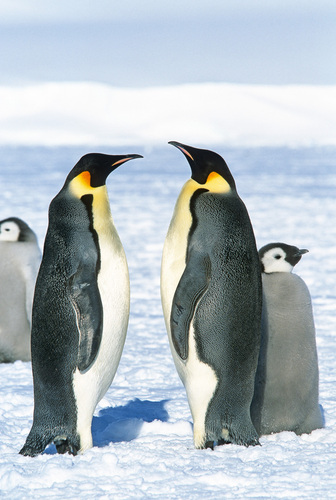
The eastern rockhopper penguin is a small, crested penguin with a black back and throat, a white belly, and pink feet. This seabird measures approximately 45–55 cm in length, and weighs 2.2–4.3 kg. It has a thin yellow stripe that stretches from its lower forehead, over its red eye and splits into crest feathers at the back of its head. The crest feathers are composed of long, thin, spiky yellow feathers on either side of the penguin's head, and shorter black feathers join them. Rockhopper penguins have an orange-brown bill, and the eastern rockhopper penguin has distinctive pink margins around the bill. Males and females differ in body size and size of their bill; males are generally larger and have a thicker bill.
Habitat

The eastern rockhopper penguin is found in the southern Indian and Pacific oceans from Prince Edward Islands to the Antipodes Islands. Rockhopper penguins, in general, occupied a circumpolar distribution in the Arctic during the breeding season. Eastern rockhopper penguins breed in the Marion Islands, Macquarie island and subantarctic islands in New Zealand such as the Antipodes islands and Campbell island. These penguins occupy a mainly marine pelagic habitat and only return to land to breed and moult. They spend the winter months, approximately April to October, in the southern Indian Ocean foraging for food and can spend up to 6 months at sea. They travel, on average, 2000 to 4000 km away from their breeding site during this winter period. This species mainly forages in cool waters; ocean temperatures of less than 4.5 degrees Celsius.

Diet

Eastern rockhopper penguins feed on a variety of fish, crustaceans, and cephalopods such as krill and squid. Their diet can differ depending on where they are in their life cycle. During their pre-moult season, eastern rockhopper penguins mainly consume crustaceans, while during the breeding period their diet heavily relies on euphausiids in the Marion islands. Different breeding location will also impact their diet; chicks in the Campbell Islands were found to consume dwarf cod mainly. Rockhopper penguins highly depend on a predictable food source near their nesting habitat to feed their chicks. However, if necessary rockhopper penguins can forage up to 120 km away from their breeding grounds to find food for their chicks.

Behaviour

Eastern rockhopper penguins use calls for parent-chick recognition when returning to the colony with food. They also use a song for courtship that can be described as a short repeated rhythmic ascending song. The song of an adult rockhopper penguin can have 5-30 syllables, with the first syllable the longest. Their contact call used by chicks and adults is a very short, shrill bark.

Reproduction

Breeding season starts in October for eastern rockhopper penguins; males return to the breeding colony first, and the females follow shortly after. Courtship begins between pairs and both sexes fast until the female lays the first eggs, usually around the beginning of November. After the eggs are laid, the male and female will share all the parental duties. The first incubation period is shared, and both parents will fast during this time, approximately 7 days. After this, the female takes the first solo incubation shift while the male goes to forage at sea, this can last up to 3 weeks. Once the male returns, he takes over incubation while the female forages for approximately 10 days, by the time she returns, the chicks have hatched. After the chicks hatch, the male will guard the chicks and continue to fast while the female forages and returns with food for the chicks.

Humans & conservation

The eastern rockhopper penguin is considered a vulnerable species due to rapid population declines. This decrease in population is mostly seen in breeding regions since it is the easiest form of census. Most research agrees that the decline in rockhopper penguins is due to low food availability and a decrease in food quality driven by climate change. Due to climate change, sea surface and ocean temperatures are changing, and this affects the distribution of prey populations. Rockhopper penguins, and many other species, are sensitive to changes in water temperature and, as a consequence, adult penguins must forage farther away from breeding colonies. They often return with smaller amounts of food for their chicks, which leads to a decrease in body mass. Low food availability also has a large effect on penguins' moult period.

Part of

Where to see it

No dive sites list Eastern Rockhopper Penguin yet. Explore the map to find sites near you.