
← All marine life
Dusky Grouper
Species IUCN · Vulnerable (VU)

Dusky Grouper

Epinephelus marginatus, (Lowe, 1834)

marine

About Dusky Grouper

Epinephelus marginatus (Latin pronunciation: [epiːˈnepʰelus marɡiˈnaːtus]), the dusky grouper, yellowbelly rock cod, or yellowbelly grouper, is a species of fish in the grouper family, Epinephelidae. It is found in coastal waters, primarily at the edges of the Atlantic Ocean – off western Africa and eastern South America – and also in the Indian Ocean around South Africa, Madagascar and Réunion, and throughout the Mediterranean.

Appearance

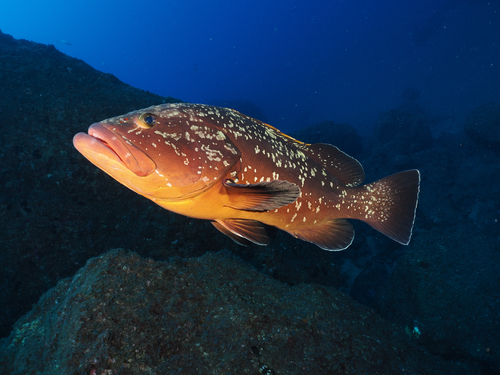
Epinephelus marginatus is a very large, oval-bodied, large-headed fish with a wide mouth, which has a protruding lower jaw. Eleven spines and 13–16 soft rays are in the dorsal fin. This species can grow up to 150 cm (59 in) in standard length, but is more commonly 90 cm (35 in).

Habitat

Epinephelus marginatus has two disjunct distribution centres; the main one is in the eastern Atlantic from the west coast of Iberia south along the western coast of Africa to the Cape of Good Hope, extending east into the south-western Indian Ocean, as far as southern Mozambique, with doubtful records from Madagascar and possibly Oman. It is found throughout the Mediterranean, too. The second population occurs in the south western Atlantic off the coast of South America in southern Brazil, Uruguay and northern Argentina. In the eastern Atlantic, it is not normally found further north than Portugal but rare occurrences have been reported from the Bay of Biscay and in the English Channel as far north as northern France, Great Britain, and Ireland.

Reproduction

E. marginatus is a protogynous hermaphrodite, meaning that all fish begin adult life as females, but as they grow larger and older, they develop into males. They attain sexual maturity at quite a late age; females begin to breed when they are around five years of age, and then between their 9th and 16th years, they change into males, most commonly at age 12. The fish start to transform into males at a length of 65 cm (26 in), although most change sex when they are between 80 and 90 cm (31 and 35 in) in total length. In some populations, the presence of large female fish suggests that not all females change sex.

Humans & conservation

Epinephelus marginatus catch declined by 88% in seven countries between 1990 and 2001; these countries form a significant part of its overall distribution. In other regions, such as West Africa, where this species is heavily exploited, few data about the status of this fish are available. For these reasons, the International Union for Conservation of Nature has assessed E. marginatus as being vulnerable, citing a suspected reduction in the population size in excess of 50% over the last three generations and with ongoing threats. Conservation measures have included a spearfishing ban for 10 years in France and bag limits in South Africa. In addition, several marine protected areas have been established to protect the habitat of E. marginatus.

Part of

Where to see it

No dive sites list Dusky Grouper yet. Explore the map to find sites near you.