← All marine life
Dusky Dolphin
Species IUCN · Least Concern (LC)

Dusky Dolphin

Lagenorhynchus obscurus

About Dusky Dolphin

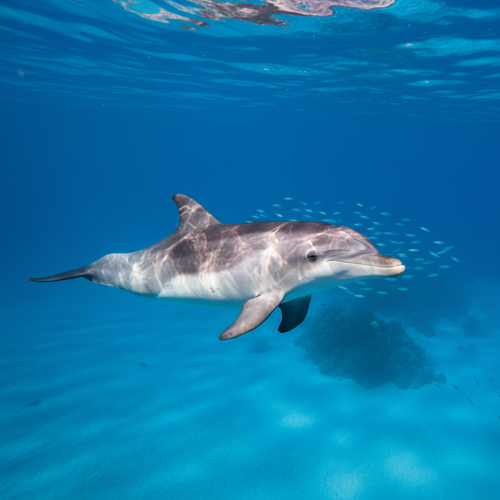
The dusky dolphin (Aethalodelphis obscurus) is a small oceanic dolphin found in coastal waters of the Southern Hemisphere. It is most closely related to the Pacific white-sided dolphin. The dolphin's range is patchy, major populations occurring around South America, southwestern Africa, New Zealand, and several oceanic islands, with some sightings around southern Australia. It has a somewhat stocky body with a short beak and a curved dorsal fin and flippers. Like its closest relative, the dusky dolphin has a multi-coloured pigmentation of black, grey, and white.

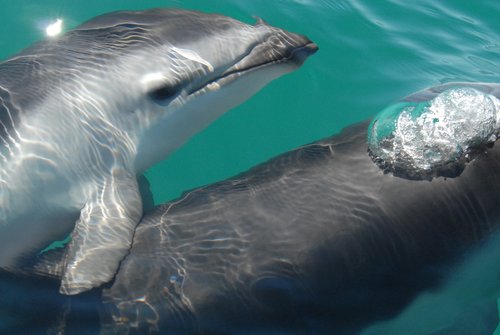
The species prefers cool currents and inshore waters. It lives in a fission–fusion society where groups change size based on social and environmental conditions. The dolphin feeds on several fish and squid species and has flexible hunting tactics, including daytime bait ball herding and nightime feeding in layers of scattered organisms. Mating is promiscuous, and several males will chase after a single female, the fittest being able to catch her and reproduce. Females raise their young in nursery groups. The dusky dolphin is known for its acrobatics, displaying leaping behaviours which vary in complexity and may or may not create splashes.

The dusky dolphin is classified as Least Concern by the IUCN Red List as many populations appear to be healthy and stable. It has been caught in gill nets and killed to be used as bait. It is a popular tourist attraction and the object of whale watching tours. Both vessels and mussel farms can interfere with the dolphin's activities.

Appearance

The dusky dolphin is a small cetacean; specimens from New Zealand have been recorded at 167–178 cm (5.48–5.84 ft) in length and 69–78 kg (152–172 lb) in weight for females and 165–175 cm (5.41–5.74 ft) in length and 70–85 kg (154–187 lb) in weight for males. Peruvian dolphins may be larger, but this is based on small sample sizes; a female was measured at 204.5 cm (6.71 ft) and a male was measured at 206 cm (6.76 ft). Newborns have an average length of 91.2 cm (2.99 ft) and a weight of 9.6 kg (21 lb) off Peru.

Habitat

The dusky dolphin has a discontiguous range in the Southern Hemisphere; including the coasts of western and southeastern South America, southwestern Africa, New Zealand, and some oceanic islands in the south Atlantic and Indian Ocean. It has also been sighted off southern Australia.

Behaviour

Dusky dolphins live mostly in coastal waters within the continental shelf and prefer cool, upwelling waters, as well as cold currents. Dolphins off Argentina and New Zealand move to and from shore between day and night and between seasons. Seasonal migrations have been recorded between Kaikōura and Admiralty Bay, New Zealand. Around Kaikōura, the majority of individuals have only been seen once in the area over a 30-year period, suggesting high levels of immigration and emigration. Dusky dolphins were recorded swimming up to 10 metres per second (36 km/h; 22 mph) and diving up to 130 m (430 ft).

Reproduction

Dusky dolphins reach sexual maturity between four and eight years depending on the region. They have a polygynandrous mating system in which both males and females mate with multiple partners. Hence, males have large testes for sperm competition. Mating groups typically consist of multiple males and one female; at Kaikōura, groups usually have a total of five members but can vary from two to fifteen. They can be found in both shallow and deep water but more often congregate near shore.

Humans & conservation

Dusky dolphins are popular attractions for dolphin watching tours. In Patagonia, dolphin watching started as an alternative to whale watching, the dusky and Commerson's dolphins being the main attractions since 1997. In 2001, 90% of boat trips encountered dusky dolphins, up from 25% two years before. Dusky dolphin watching is also popular in New Zealand, whose dolphin-watching industry started in the late 1980s as a side attraction to sperm whale watching. By 2010, the number of official whale- and dolphin-watching tour operators in the country had risen to around 75.

Part of

Where to see it

No dive sites list Dusky Dolphin yet. Explore the map to find sites near you.