
← All marine life
Daisy Stingray
Species IUCN · Vulnerable (VU)

Daisy Stingray

Fontitrygon margarita, (Günther, 1870)

marinebrackish

About Daisy Stingray

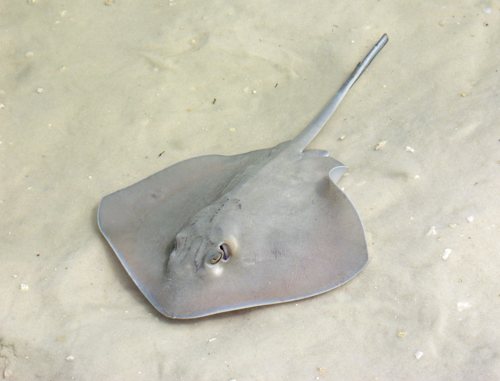
The daisy stingray, Fontitrygon margarita, is a little-known species of stingray in the family Dasyatidae, found in shallow waters along the coast of West Africa. This species typically grows to 60 cm (24 in) across and has a rounded pectoral fin disc and (in adults) a wide band of dermal denticles over its back. It is characterized by a greatly enlarged, nacreous denticle in the middle of its back called a "pearl spine"; this feature is shared with the similar but much smaller pearl stingray (F. margaritella), which has often been confused with this species. The daisy stingray feeds mainly on crustaceans and exhibits aplacental viviparity, with litters of 1–4 young. Heavily pressured by fisheries and possibly habitat degradation, this once-common species is declining and has been assessed as Vulnerable by the International Union for Conservation of Nature (IUCN).

Appearance

The pectoral fin disc of the daisy stingray is moderately thin and rounded, measuring about as wide as long. The leading margins of the disc are concave and converge at the pointed, slightly projecting tip of the snout. The eyes are medium-sized and followed by somewhat larger spiracles. There is a curtain of skin between the nares, with a fringed, subtly tri-lobed posterior margin; a pair of shallow grooves run from the skin flap to the corners of the bow-shaped mouth. There are 5 papillae in a transverse row across the floor of the mouth, with the outermost pair set apart from the others. The tooth rows number 24–32 in the upper jaw and 28–36 rows in the lower jaw, and are arranged with a quincunx pattern into pavement-like surfaces. The pelvic fins are short, with the tips projecting just past the disc margin.
Habitat

The known range of the daisy stingray extends from Senegal to the Democratic Republic of the Congo; records of it occurring as far as Mauritania and Angola may have been mistakenly based on the pearl stingray. This bottom-dwelling species is found in marine and brackish waters with a salinity of 20–40 ppt. It favors sandy habitats in shallow coastal waters to a depth of 60 m (200 ft), though most are found between 11 and 20 m (36 and 66 ft). This ray also reportedly frequents lagoons and estuaries; however, this also requires confirmation due to confusion with the pearl stingray.

Behaviour

Little is known of the natural history of the daisy stingray. It feeds mainly on shrimp, crabs, bivalves, and annelid worms. Off Nigeria, some three-quarters of its diet consists of the shrimp Farfantepenaeus duorarum. Like other stingrays, this species is aplacental viviparous. Females bear litters of 1–4 pups, with coastal lagoons and estuaries serving as a breeding ground. Reproductive activity peaks during the rainy season from April to September, likely to correspond to high abundances of prey species.

Humans & conservation

The tail spine of the daisy stingray is reportedly highly venomous and potentially injurious to humans. The daisy stingray is caught by intensive artisanal and small-scale commercial fisheries occurring off the coasts of Senegal, Ghana, and Côte d'Ivoire, and sold fresh, smoked, or dried and salted for human consumption. A wide variety of fishing gear is used, including longlines, bottom trawls, trammel nets, gillnets, traps, beach seines, and hook-and-line. Habitat degradation from agricultural runoff and industrial development may also threaten its population. Once common, catches of this slow-reproducing ray have become scarce in recent years, leading the International Union for Conservation of Nature (IUCN) to assess it as Vulnerable. The daisy stingray has not yet been the target of any specific conservation schemes.

Part of

Where to see it

No dive sites list Daisy Stingray yet. Explore the map to find sites near you.