
← All marine life
Crabeater Seal
Species IUCN · Least Concern (LC)

Crabeater Seal

Lobodon carcinophaga, (Hombron & Jacquinot, 1842)

marine

About Crabeater Seal

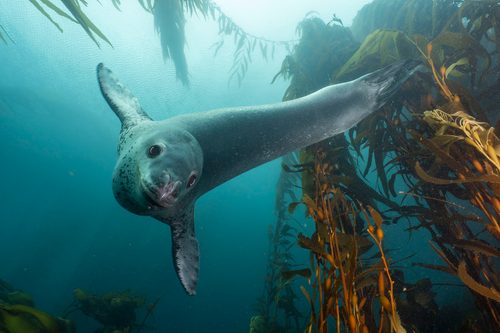
The crabeater seal (Lobodon carcinophaga), also known as the krill-eater seal, is a true seal with a circumpolar distribution around the coast of Antarctica. They are the only member of the genus Lobodon. They are medium- to large-sized (over 2 m (6.6 ft) in length), relatively slender and pale-colored, found primarily on the free-floating pack ice that extends seasonally out from the Antarctic coast, which they use as a platform for resting, mating, social aggregation and accessing their prey. They are by far the most abundant seal species in the world. While population estimates are uncertain, there are at least 7 million and possibly as many as 75 million individuals. This success of this species is due to its specialized predation on the abundant Antarctic krill of the Southern Ocean, for which it has uniquely adapted, sieve-like tooth structure. Indeed, its scientific name, translated as "lobe-toothed (lobodon) crab eater (carcinophaga)", refers specifically to the finely lobed teeth adapted to filtering their small crustacean prey.

Despite its name, the crabeater seal does not eat crabs.

As well as being an important krill predator, the crabeater seal's pups are an important component of the diet of leopard seals (H. leptonyx).

Appearance

Adult seals (over five years old) grow to an average length of 2.3 m (7.5 ft) and an average weight of around 200 kg (440 lb). Females are on average 6 cm (2.4 in) longer and around 8 kilograms (18 lb) heavier than males, though their weights fluctuate substantially according to season; females can lose up to 50% of their body weight during lactation, and males lose a significant proportion of weight as they attend to their mating partners and fight off rivals. During summer, males typically weigh 200 kilograms (440 lb), and females 215 kilograms (474 lb). A molecular genetic based technique has been established to confirm the sex of individuals in the laboratory. Large crabeater seals can weigh up to 300 kg (660 lb). Pups are about 1.2 metres (3.9 ft) in length and 20 to 30 kilograms (44 to 66 lb) at birth.
Habitat

Crabeater seals have a continuous circumpolar distribution surrounding Antarctica, with only occasional sightings or strandings in the extreme southern coasts of Argentina, South Africa, Australia and New Zealand. They spend the entire year on the pack ice zone as it advances and retreats seasonally, primarily staying within the continental shelf area in waters less than 600 m (2,000 ft) deep. They colonized Antarctica during the late Miocene or early Pliocene (15–25 million years ago), at a time when the region was much warmer than today. The population is connected and fairly well mixed (panmictic), and genetic evidence does not suggest any subspecies separations. A genetic survey did not detect evidence of a recent, sustained genetic bottleneck in this species, which suggests that populations do not appear to have suffered a substantial and sustained decline in the recent past.

Diet

Young crabeater seals experience significant predation by leopard seals. Indeed, first-year mortality is exceedingly high, possibly reaching 80%, and up to 78% of crabeaters that survive through their first year have injuries and scars from leopard seal attacks. Long scars and sets of parallel scars, visible on the otherwise pale and relatively unmarked pelage of crabeaters, are present on nearly all young seals. The incidence of visible scars falls off significantly after the first year, suggesting leopard seals primarily target the young of the year. The high predation pressure has clear impacts on the demography and life history of crabeater seals, and has likely had an important role in shaping social behaviors, including aggregation of subadults.

Behaviour

Crabeater seals have a typical, serpentine gait when on ice or land, combining retractions of the foreflippers with undulations of the lumbar region. This method of locomotion leaves a distinctive sinuous body track and can be extremely effective. When not subject to overheating (i.e. on cold days), speeds on land of 19–26 km/h (12–16 mph) have been recorded for short distances. Satellite tracking data have resulted in conservative estimates of swimming speeds of 66 km/day and 12.7 km/h. While swimming, crabeaters have been known to engage in porpoising (leaping entirely out of the water) and spyhopping (raising the body vertically out of the water for visual inspection) behaviors.

Part of

Where to see it

No dive sites list Crabeater Seal yet. Explore the map to find sites near you.