
← All marine life
Coral Trout
Species IUCN · Least Concern (LC)

Coral Trout

Plectropomus leopardus, (Lacepède, 1802)

marine

About Coral Trout

The leopard coral grouper (Plectropomus leopardus), also known as the common coral trout, leopard coral trout, blue-dotted coral grouper or spotted coral grouper, is a species of marine ray-finned fish, a grouper from the family Epinephelidae. It is found in the Western Pacific Ocean.

Coral trout are the favourite target fish for all sectors of the fishery because they are a good food fish and command high market prices locally and overseas. The total commercial catch of coral trout was reported at over 1500 tonnes in 1998.

Appearance

The leopard coral grouper has a body which is elongate and robust, with the standard length being 2.9 to 3.9 times the depth of the body. The preopercle is mostly rounded, with three large, downward pointing spines along the bottom half. The dorsal fin contains 7–8 spines and 10–12 soft rays while the anal fin contains 3 spines and 8 soft rays. The spiny part of the dorsal fin has a shorter base than the soft-rayed part. The caudal fin is a emarginate.

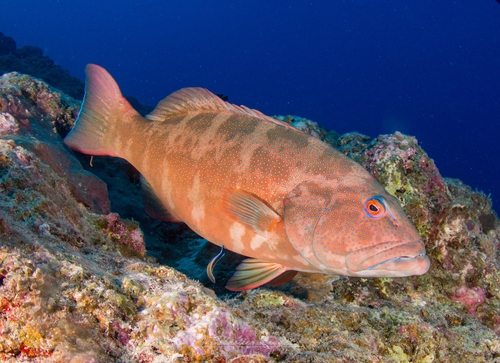
The background colour is olive green to reddish brown or orange-red and its upper body is covered in regularly-spaced bright blue spots and there is a blue ring around the eye, this may be broken up. They are able to quickly change colour, and frequently take on a mottled pattern as they hunt.

Habitat

The leopard coral grouper is found in the western Pacific where it is distributed from southern Japan to Australia and from the east coast of Thailand and Malaysia east to the Solomon Islands, Caroline Islands and Fiji.

In Australia it is found at Beacon Island in Western Australia, the Ashmore and Cartier Islands in the Timor Sea, around the tropical northcoast as far south as Sydney. This range includes reefs in the Coral Sea, Christmas Island, Cocos (Keeling) Islands and around Lord Howe Island in the Tasman Sea.

Diet

Leopeard coral groupers are largely piscivores (fish-eating predators). Younger juvenile trout mostly eat crustaceans, especially prawns, which live on or near the reef bottom. However, adults feed upon a variety of reef fish. The most common type of fish eaten is damselfish (family Pomacentridae), particularly the spiny chromis damselfish (Acanthochromis polyacanthus). Adult coral trout also eat juveniles of their own species. Individual coral trout usually feed once every 1–3 days, although they may go for many days without feeding. About 90% of a prey item will be digested within 24 hours. This species only feeds during daylight hours, most often at dusk and dawn. Coral trout hunt by ambush and by prowling. They use the ambush method to hunt fish that live among the coral on the reef bottom. The trout hide and remain very still and alert, ready to attack passing prey.

Reproduction

A project called the "Effects of Line Fishing" project studied populations to assess the size and age structures during reproduction of leopard coral grouper stocks to ascertain how fish stocks respond to various levels of fishing pressure. They are protogynous hermaphrodites, starting their lives as females, and change sex later in life. The trigger of this sex change is unknown. On average, sex change occurs when fish are between 23 and 62 cm (9.1 and 24.4 in) in length; the average length at sex change is 42 cm (17 in). This is believed to happen most frequently in the months immediately following spawning. The ELF research has determined that the sex ratio differs in different areas of the Great Barrier Reef, and may differ between reefs opened and protected from fishing.

Part of

Where to see it

No dive sites list Coral Trout yet. Explore the map to find sites near you.