← All marine life
Conger Eel
Group IUCN · Least Concern (LC)

Conger Eel

Conger conger, (Linnaeus, 1758)

marine
Where to see it

About Conger Eel

The European conger (Conger conger) is a species of conger of the family Congridae. It is the heaviest eel in the world and native to the northeast Atlantic, including the Mediterranean Sea.

Appearance

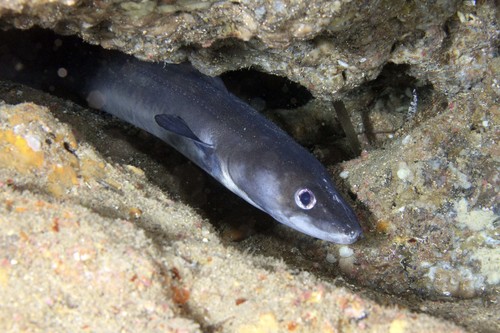
European congers have an average adult length of 1.5 m (5 ft), a maximum known length of around 3 m (9.8 ft) and maximum weight of roughly 72 kg (159 lb), but possibly up to 160 kg (350 lb), making them the largest eels in the world by weight. They can be rivaled or marginally exceeded in length by the largest species of moray eel but these tend to be slenderer and thus weigh less than the larger congers. Average specimens caught will weigh only 2.5 to 25 kg (5.5 to 55.1 lb). Females, with an average length at sexual maturity of 2 m (6 ft 7 in), are much larger than males, with an average length at sexual maturity of 1.2 m (3 ft 11 in).
Habitat

This species can be found in the eastern Atlantic from Norway and Iceland to Senegal, and also in the Mediterranean and Black Sea at 0–500 m (0–1,640 ft) of depth, although they may reach depths of 3,600 m (11,800 ft) during their migrations.

It is sometimes seen in very shallow water by the shore, but can also go down to 1,170 m (3,840 ft). It is usually present on rough, rocky, broken ground, close to the coast when young, moving to deeper waters when adult.

In the northern Adriatic Sea, congers are among the primary fish species that inhabit tegnùe, reefs formed from formations of sedimentary and organogenic rocks common across the seafloor.

Behaviour

Conger eels have habits similar to moray eels. They usually live amongst rocks in holes, or "eel pits", sometimes in one hole together with moray eels. They come out from their holes at night to hunt. They are nocturnal predators that mainly feed on fish, cephalopods, and crustaceans, and are thought to scavenge on dead and rotting fish, as well as actively hunt live fish.

Congers can be aggressive to humans, and large specimens can pose a danger to divers.

Reproduction

When conger eels are between 5 and 15 years old, their bodies undergo a transformation, with the reproductive organs of both males and females increasing in size and the skeleton reducing in mass and the teeth falling out. Females appear to increase in weight and size more than the males. Conger eels then make migrations to spawning areas in the Mediterranean and the Atlantic, "although the existence of one or multiple spawning grounds for the species remains uncertain". The female conger eels produce several million eggs, and both the females and males die after spawning. Once hatched, the larval conger eels begin to swim back to shallower waters, where they live until they reach maturity. They then migrate to repeat the cycle.

Humans & conservation

Historic evidence of human consumption of European congers dates to the Middle Pleistocene during the Last Interglacial. The Neanderthal site at Gruta da Figueira Brava, Portugal, shows evidence of recurring capture and cooking of congers alongside other eel species such as European eels and Mediterranean morays.

Conger is traditionally considered one of the "three fishes" used to make the Provençal fish stew Bouillabaisse, alongside rascasse and grondin (any of a number of species of gurnards or sea robin).

Species in this group

Where to see it

Top-rated dive sites where divers have spotted Conger Eel.

El Acuario Ii

El Acuario Ii

⭐ 4.0 Scout Score
Spain, Almería Cabo de Gata-Níjar Natural Park
Vibrant site with diverse marine life and interesting topography.
🚤 Boat beginner/intermediate
Gustinja

Gustinja

⭐ 4.0 Scout Score
Dive site with abundant marine life near Rovinj.
🚤 Boat All Levels
100 Steps Vrbnik

100 Steps Vrbnik

⭐ 4.0 Scout Score
Croatia, Krk Not in marine park
Dramatic wall dive with caves and diverse macro life.
👣 Shore All levels
Hermenegildo Capelo (Wreck)

Hermenegildo Capelo (Wreck)

⭐ 4.0 Scout Score
Portugal Ocean Revival Underwater Park
Wreck dive with abundant marine life in Portugal
🚤 Boat Intermediate
Piedra de la Higuera

Piedra de la Higuera

⭐ 4.0 Scout Score
Spain, Costa Tropical, La Herradura Acantilados y Fondos Marinos de la Punta de la Mona
Submerged pinnacle with dramatic topography and diverse Mediterranean marine life.
🚤 Boat all levels
Sea Hawk Dive Boat

Sea Hawk Dive Boat

⭐ 3.0 Scout Score
Challenging cold-water wreck diving with seasonal shark encounters.
🚤 Boat advanced
Poblat Iberic

Poblat Iberic

⭐ 4.0 Scout Score
Underwater pinnacles covered in vibrant red gorgonian sea fans.
🚤 Boat intermediate
Secca di Marassi

Secca di Marassi

⭐ 4.0 Scout Score
Secca di Marassi: Italian wall dive with eels and lobsters
🚤 Boat Intermediate
Marie Grota Cave/cliff

Marie Grota Cave/cliff

⭐ 4.0 Scout Score
Advanced cave and deep cliff dive on Šolta island.
🚤 Boat advanced
Plovanov Stol

Plovanov Stol

⭐ 4.0 Scout Score
Croatia, Vis Not in marine park
Spectacular wall dive covered in vibrant yellow and red gorgonians.
🚤 Boat All levels
Lun, Pag

Lun, Pag

⭐ 4.0 Scout Score
Croatia, Pag Not in marine park
Dramatic underwater cliffs and walls with excellent Adriatic visibility.
🚤 Boat All levels
La Cala del Peñon

La Cala del Peñon

⭐ 4.0 Scout Score
Spain, Almería, Cabo De Gata Cabo de Gata-Níjar Natural Park
Shallow boat dive over Posidonia meadows with abundant fish.
🚤 Boat beginner
Porer Island

Porer Island

⭐ 4.0 Scout Score
Croatia, Pula Cape Kamenjak Protected Landscape
Lighthouse island with dramatic walls and abundant marine life.
🚤 Boat All levels
Kamicac

Kamicac

⭐ 4.0 Scout Score
Croatia, Vis Not in marine park
Dramatic wall dive around a small islet near Vis.
🚤 Boat Intermediate
Pecio la Dragonera

Pecio la Dragonera

⭐ 4.0 Scout Score
Spain, Tarragona Marine Reserve
Famous 65m cargo ship wreck in a marine reserve.
🚤 Boat intermediate
El Galeon

El Galeon

⭐ 4.0 Scout Score
Shallow archeological wreck dive of a historic French galleon.
🚤 Boat beginner
Balun

Balun

⭐ 4.0 Scout Score
Croatia, Kornati Islands Kornati National Park
Spectacular underwater cliff dive with rich Adriatic marine life.
🚤 Boat Advanced
Plomin

Plomin

⭐ 4.0 Scout Score
Croatia, Istria Not in marine park
Famous WWI shipwreck dive site next to a vertical wall.
🚤 Boat Advanced
Punta Penne

Punta Penne

⭐ 4.0 Scout Score
Varied topography with rich Mediterranean life for all levels.
all levels
Black Rocks

Black Rocks

⭐ 4.0 Scout Score
Croatia, Rovinj Not in marine park
Dramatic underwater canyons and swim-throughs with excellent visibility.
🚤 Boat Intermediate