← All marine life
Common Dolphin
Species IUCN · Least Concern (LC)

Common Dolphin

Delphinus delphis, Linnaeus, 1758

marine

About Common Dolphin

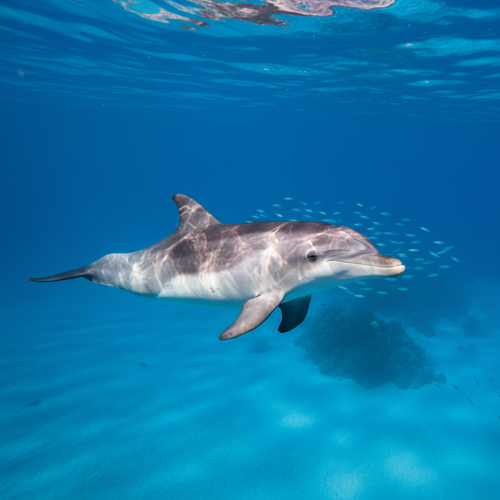
The common dolphin (Delphinus delphis) is the most abundant cetacean in the world, with an estimated global population of about six million. It is currently the only member of the genus Delphinus, the type genus of the subfamily Delphininae. This places it as a close relative of the bottlenose dolphin, humpback dolphin, striped dolphin, spinner dolphin, Clymene dolphin, spotted dolphin, Fraser's dolphin, the tucuxi, and the Guiana dolphin.

The common dolphin was once divided into two different species, the short-beaked common dolphin and the long-beaked common dolphin. These are now generally regarded as ecotypes. Recent research shows that many long-beaked populations worldwide are not closely related to one another, often originating from short-beaked ancestors, and they do not consistently share the same derived traits. For this reason, these forms are no longer classified as separate species.

Despite its name, the common dolphin is not widely considered the "archetypal" dolphin; that role is more often associated with the bottlenose dolphin, largely because of its frequent appearances in aquaria and the media. Nevertheless, the common dolphin held cultural significance in antiquity and frequently appeared in Greek and Roman art, such as in murals created by the Minoan civilization.

Appearance

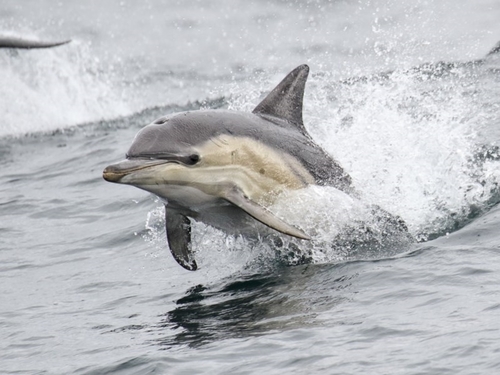
Common dolphin are medium-sized dolphins; adults range between 1.9 and 2.5 m (6.2 and 8.2 ft) long, and can weigh between 80–235 kg (176–518 lb), although the range between 80–150 kg (180–330 lb) is more common. Males are generally longer and heavier. The dolphin's coloration is unusual, with a dark back and white belly (countershading), while on each side is an hourglass pattern colored light grey, yellow, or gold in front and dirty grey in back. They have long, thin rostra with up to 50–60 small, sharp, interlocking teeth on each side of each jaw.

Behaviour

Common dolphins can live in aggregations or "pods" of hundreds or even thousands of dolphins. Common dolphins are often seen in groups numbering several hundred individuals (with subgroups consisting of 20–30 individuals). Occasionally, different groups will come together to form mega-pods which can consist of over 10,000 dolphins. Genetic studies in the Northeast Atlantic suggest that common dolphin pods generally do not consist of close kin, but rather of members that are not closely related. Unlike many delphinids, common dolphins do not live in a matriarchal society. That being said, closely related individuals are usually found in similar geographical locations fairly consistently, providing evidence that this species displays site fidelity (at least in the Northeastern Atlantic). Male common dolphins display greater site fidelity in relation to their kin than females.

Reproduction

The short-beaked common dolphin has a gestation period of 10 to 11 months. The newborn calf has a length of 70 to 100 centimetres (2.3 to 3.3 ft) and weighs about 10 kilograms (22 lb). For the Black Sea population, weaning occurs at between five and six months, but occurs later (up to about 19 months) in other areas. Typical interbirth interval ranges from one year for the Black Sea population to three years for eastern Pacific Ocean populations. Age of sexual maturity also varies by location, but can range between 2 and 7 years for females and 3 and 12 years for males. No evidence exists of any major reproductive differences between the two forms.

Humans & conservation

Common dolphins are not common in captivity. Despite this, on multiple occasions, a beached common dolphin in California was nursed back to health at SeaWorld San Diego, but deemed unfit to release back to the ocean. These common dolphins remained at SeaWorld with the bottlenose dolphin exhibit. On one occasion, a male common dolphin managed to impregnate one of the female bottlenose dolphins in the exhibit, leading to four hybrid births. One of the resulting common dolphin/bottlenose dolphin hybrids remained at SeaWorld, San Diego (alternately under the name Cindy or Bullet) while the other (named CJ) was kept at Discovery Cove, and was moved to SeaWorld Orlando in 2016. In 2024, the species returned to SeaWorld San Diego after a pair of rescued common dolphins were stranded on local beaches.

Part of

Where to see it

No dive sites list Common Dolphin yet. Explore the map to find sites near you.