
← All marine life
Caspian Seal
Species IUCN · Endangered (EN)

Caspian Seal

Pusa caspica, Gmelin, 1788

marine

About Caspian Seal

The Caspian seal (Pusa caspica, syn. Phoca caspica) is one of the smallest members of the earless seal family and unique in that it is found exclusively in the brackish Caspian Sea. It lives along the shorelines, but also on the many rocky islands and floating blocks of ice that dot the Caspian Sea. In winter and cooler parts of the spring and autumn season, it populates the northern Caspian coastline. As the ice melts in the summer and warmer parts of the spring and autumn season, it also occurs in the deltas of the Volga and Ural Rivers, as well as the southern latitudes of the Caspian where the water is cooler due to greater depth.

Evidence suggests that the colonization events of Caspian seals were probably facilitated by river connections from the Arctic that have since disappeared, land-locking the populations sometime before the major Pleistocene glaciations.

Since the beginning of the 1900s, the population has dropped by over 90%. In 2022, a substantial die-off of the endangered species was reported, threatening the isolated population at an estimated number from fewer than 70,000 by the Caspian Seals Research and Rehabilitation Center to 168,000 by the Marine Mammal Protected Areas Task Force.

Appearance

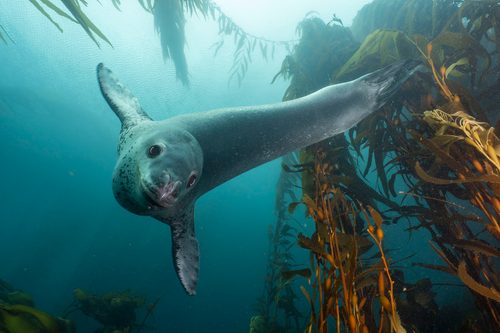
Adults are about 126–129 cm (50–51 in) in length. Males are longer than females at an early age, but females experience more rapid growth until they reach ten years of age. Males can grow gradually until they reach an age of about 30 or 40 years. Their lifespan is around 40-50 years. The maximum reported size is 1.8 m (5 ft 11 in) in length and 86 kg (190 lb) in weight. males are generally larger and bulkier. Their dental formula is 3.1.4.22.1.4.1.

The skull structure of the Caspian seal suggests it is closely related to the Baikal seal. In addition, the morphological structures in both species suggest they are descended from the ringed seal which migrated from larger bodies of water around two million years ago.
Habitat

The seal is found exclusively in the Caspian Sea, which is nestled between 5 countries; Azerbaijan, Iran, Kazakhstan, Russia, and Turkmenistan. Caspian seals can be found not only along the shorelines, but also on the many rocky islands and floating blocks of ice that dot the Caspian Sea. During winter, seals migrate northward in the Caspian to mate, give birth, and care for their young on the frozen ice. As the ice melts in the warmer season, they can be found on the mouths of the Volga and Ural Rivers, as well as the southern latitudes of the Caspian where cooler waters can be found due to greater depth.

Diet

Caspian seals are primarily piscivorous. They eat a variety of food depending on season and availability. A typical diet for Caspian seals found in the northern Caspian sea consists of crustaceans and various fish species, such as Clupeonella engrauliformis, C. grimmi, C. caspia, Gobiidae, Rutilus caspicus, Atherina boyeri, and Sander lucioperca. Caspian seal adults eat about 2–3 kg (4–7 lb) of fish a day and almost a metric ton of fish per year.

In autumn and winter, Caspian seals prey mostly on sculpins, gobies, and crustaceans while inhabiting shallow waters in the northern part of the sea. During the summer, in the southern part of the Caspian Sea, they eat herring, roach, carp, sprat, and smelt. When Caspian seals live in estuaries, they eat large amounts of the freshwater species, Sander lucioperca. Other prey include shrimp, crab, and silversides.

Behaviour

Caspian seals are shallow divers, typically diving 50 m (160 ft) for about one minute, although scientists have recorded Caspian seals diving deeper and for longer periods of time. After foraging during a dive, they rest at the surface of the water.

In the summer and winter, during mating season, Caspian seals tend to live in large groups. At other times of the year, these seals are solitary. During the summer, however, they make aggressive snorts or use flipper waving to tell other seals to keep their distance. Little else is known about their behavior.

Reproduction

Male and female Caspian seals are monogamous. Among breeding seals, a lack of fighting for a mate seems prevalent. In late autumn, Caspian seals travel to the northern part of the Caspian Sea where the water is shallow and frozen to give birth in secluded areas on ice sheets after a gestation period of 11 months. Normally, pregnancy rates are 40 to 70%, but are currently at an all-time low of 30%. In late January to early February, female seals give birth to one pup each. Similar to other ringed seals, these pups are born with white pelages and weigh about 5 kg (11 lb). Caspian seals employ a capital breeding lactation strategy, where the mother will fast while nursing the pup, sometimes with a small amount of supplemental feeding. Pups are weaned after a few weeks. The pups' white coats are molted at around three weeks to a month.

Humans & conservation

Several recent cases of large numbers of Caspian seals dying due to canine distemper virus have been reported, in 1997, 2000 and 2001. In April 2000, a mass die-off of Caspian seals was first reported near the mouth of the Ural River in Kazakhstan. It spread south to the Mangistau region, and by the end of May, more than 10,000 seals had died along the Kazakhstan coast. High death rates were also recorded in May and June along the Apsheron peninsula of Azerbaijan and the Turkmenistan coast.

Part of

Where to see it

No dive sites list Caspian Seal yet. Explore the map to find sites near you.