
← All marine life
California Sea Lion
Species IUCN · Least Concern (LC)

California Sea Lion

Zalophus californianus, (Lesson, 1828)

marine

About California Sea Lion

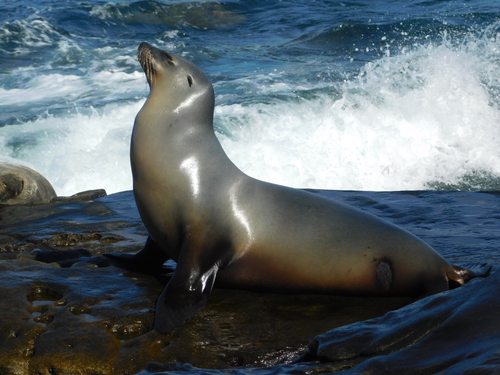
The California sea lion (Zalophus californianus) is a coastal eared seal native to western North America. It is one of six species of sea lions. Its natural habitat ranges from southeast Alaska to central Mexico, including the Gulf of California. California sea lions are sexually dimorphic; males are larger than females, and have a thicker neck, and a protruding sagittal crest. They mainly haul out on sandy or rocky beaches, but they also frequent manmade environments such as marinas and wharves. California sea lions feed on a number of species of fish and squid, and are preyed on by orcas and great white sharks.

California sea lions have a polygynous breeding pattern. From May to August, males establish territories and try to attract females with which to mate. Females are free to move in between territories, and are not coerced by males. Mothers nurse their pups in between foraging trips. California sea lions communicate with numerous vocalizations, notably with barks and mother-pup contact calls. Outside their breeding season, California sea lions spend much of their time at sea, but they come to shore to molt.

Appearance

Being sexually dimorphic, California sea lions differ in size, shape, and coloration between the sexes. Males can grow up to 2.5–2.7 m (8.2–8.9 ft) long and weigh around 350 kg (770 lb), while females are typically around 2.1 m (6.9 ft) and weigh around 100 kg (220 lb). The heaviest recorded male weighed 660 kg (1,460 lb).

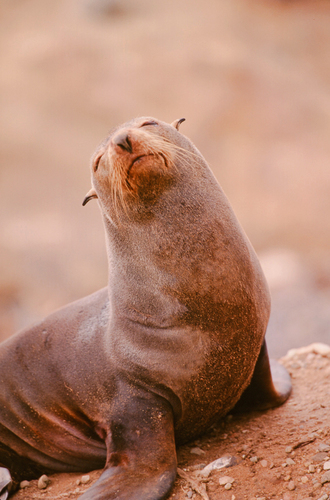
Females and juveniles have a tawny brown pelage, although they may be temporarily light gray or silver after molting. The pelage of adult males can be anywhere from light brown to black, but is typically dark brown. The face of adult males may also be light tan in some areas. Pups have a black or dark brown pelage at birth.
Habitat

The California sea lion ranges along the western coast and islands of North America, from southeast Alaska to central Mexico. Mitochondrial DNA sequences in 2009 have identified five distinct California sea lion populations: the U.S. or Pacific Temperate stock, the Western Baja California or Pacific Tropical stock, and the Southern, Central, and Northern Gulf of California stocks. The U.S. stock breeds mainly in the Channel Islands, although some breeding sites may be established in northern California, and females are now commonly found there. The Western Baja California stock mainly breeds near Punta Eugenia and at Isla Santa Margarita. The above-mentioned stocks are separated by the Ensenada Front. The stocks of the Gulf of California live in the shallow waters of the north (Northern stock), the tidal islands near the center (Central stock), and the mouth of the bay (Southern stock).

Diet

California sea lions are preyed on by orcas and large sharks. At Monterey Bay, California sea lions appear to be the more common food items for transient mammal-eating orcas pods. The California sea lions may respond to the dorsal fin of a killer whale and remain vigilant, even when encountering resident fish-eating pods. California sea lions are also common prey for great white sharks. They have been found with scars made by attacks from both great white sharks and shortfin mako sharks. Sharks attack California sea lions by ambushing them while they are resting at the surface. California sea lions that are attacked in the hindquarters are more likely to survive and make it to the shore.

Behaviour

California sea lions feed on a wide variety of seafood, mainly octopus, squid and fish, and sometimes clams. Commonly eaten fish and squid species include salmon, hake, Pacific whiting, anchovy, herring, rockfish, lamprey, dogfish, and market squid. They mostly forage near mainland coastlines, the continental shelf, and seamounts. They may also search along the ocean bottom. California sea lions may eat alone or in small to large groups, depending on the amount of food available. They sometimes cooperate with other predators, such as dolphins, porpoises, and seabirds, when hunting large schools of fish. California sea lions sometimes follow dolphins and exploit their hunting efforts. Adult females feed between 10–100 km (6.2–62.1 mi) from shore. Adult males may forage as far as 450 km (280 mi) from shore when water temperatures rise.

Reproduction

Outside the breeding season, males migrate to the northern ends of the species range to feed, while females forage near the breeding rookeries. California sea lions can stay at sea for as long as two weeks at a time. They make continuous dives, returning to the surface to rest. California sea lions may travel alone or in groups while at sea and haul-out between each sea trip. Adult females and juveniles molt in autumn and winter; adult males molt in January and February. California sea lions in the Gulf of California do not migrate; they stay in the Gulf of California year-round.

Humans & conservation

The IUCN lists the California sea lion as Least Concern due to "its large and increasing population size." The estimated population is 238,000–241,000 for the U.S. or Pacific Temperate stock, 75,000–85,000 for the Western Baja California or Pacific Tropical stock, and 31,393 for the population in the Gulf of California. Off the Pacific coast of the United States, California sea lions are so numerous that they are close to carrying capacity, while the Gulf of California population declined by 20% by 2008. California sea lions may be killed when in conflict with fishermen, by poaching, and by entanglements in human-made garbage. They are also threatened by pollutants like DDT and PCB which accumulate in the marine food chain.

Part of

Where to see it

No dive sites list California Sea Lion yet. Explore the map to find sites near you.