← All marine life
Bristle Worm
Group

Bristle Worm

Polychaeta, Grube, 1850

marinebrackishfreshwater

About Bristle Worm

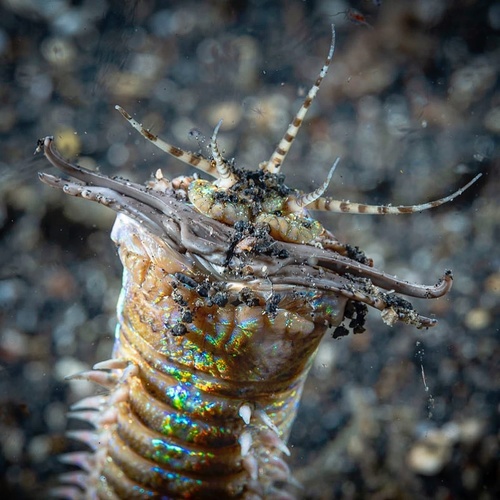
Polychaeta is a paraphyletic class of generally marine annelid worms, commonly called bristle worms or polychaetes. Each body segment has a pair of fleshy protrusions called parapodia which bear many chitinous bristles called chaetae, hence their name.

More than 10,000 species have been described in this diverse and widespread class; in addition to inhabiting all of the world's oceans, polychaetes occur at all ocean depths, from planktonic species living near the surface, to a small undescribed species observed through a ROV at the deepest region in the Earth's oceans, Challenger Deep. In addition, many species live on the abyssal plains, coral reefs, parasitically, and a few within fresh water.

Commonly encountered representatives include the lugworms, bloodworms, and species of Alitta such as the clam worm and sandworm or ragworm; these species inhabit shallow water marine environments and coastlines of subtropical and temperate regions around the world and may be used as fishing bait. More exotic species include the stinging fireworms, the predatory and large-bodied bobbit worm, the culturally important palolo worm, the bone-eating worms, and giant tube worms, which are extremophiles that tolerate near-boiling water near hydrothermal vents.

Appearance

Polychaetes are segmented worms, generally less than 10 cm (4 in) in length, although ranging at the extremes from 1 mm (0.04 in) to 3 m (10 ft), in Eunice aphroditois. They can sometimes be brightly coloured, and may be iridescent or even luminescent. Each segment bears a pair of paddle-like and highly vascularized parapodia, which are used for movement and, in many species, act as the worm's primary respiratory surfaces. Bundles of bristles, the chaetae, project from the parapodia.

Behaviour

Polychaetes are extremely variable in both form and lifestyle, and include a few taxa that swim among the plankton or above the abyssal plain. Most burrow or build tubes in the sediment, and some live as commensals. A few species, roughly 80 (less than 0.5% of species), are parasitic. They are predominantly marine, but 168 species (nearly 2% of total species) also live in freshwater, and a few in semiterrestrial environments and even in caves. The mobile forms (Errantia) tend to have well-developed sense organs and jaws, while the stationary forms (Sedentaria) lack them, but may have specialized gills or tentacles used for respiration and deposit or filter feeding, e.g., fanworms. Polychaete mouthparts are reversible and used to capture prey.

Reproduction

Most polychaetes have separate sexes, rather than being hermaphroditic. The most primitive species have a pair of gonads in every segment, but most species exhibit some degree of specialisation. The gonads shed immature gametes directly into the body cavity, where they complete their development. Once mature, the gametes are shed into the surrounding water through ducts or openings that vary between species, or in some cases by the complete rupture of the body wall (and subsequent death of the adult). A few species copulate, but most fertilize their eggs externally.

Species in this group

Where to see it

No dive sites list Bristle Worm yet. Explore the map to find sites near you.