
← All marine life
Bobbit Worm
Species

Bobbit Worm

Eunice aphroditois, (Pallas, 1788)

marine

About Bobbit Worm

Eunice aphroditois is a benthic bristle worm of warm marine waters. It lives mainly in the Atlantic Ocean, but can also be found in the Indo-Pacific. It ranges in length from less than 10 cm (4 in) to nearly 3 m (10 ft). Its exoskeleton displays a wide range of colors, from black to purple and more. This species is an ambush predator; it hunts by burrowing its whole body in soft sediment on the ocean floor and waiting until its antennae detect prey. It then strikes with its sharp mandibles. It may also be found among coral reefs.

The species is called the sand striker or trap-jaw worm. Traces of their burrows have been found among fossils near Taiwan dating back 20 million years. A highly popularized name is bobbit worm or bobbitt worm, which is believed to derive from the John and Lorena Bobbitt case.

Appearance

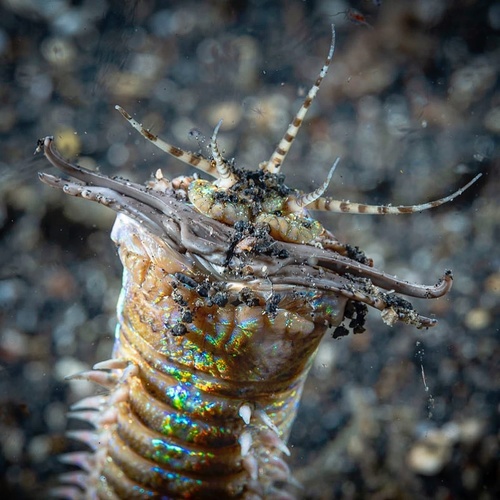
These ambush predators have five antennae on their head that are used to sense prey. The body is covered by a hard exoskeleton. The mandibles can be retracted inside the body and are responsible for striking and stunning prey; they are capable of snapping some prey in half.

Typically, E. aphroditois ranges from deep purple to black, with an iridescent skin. The largest known specimen on record reached 299 cm (9.81 ft) in length, making it the longest known member of the polychaete class. Despite these great lengths, the worms are slim, with the body only about 25.5 mm (1.00 in) wide.

Habitat

This species may be found prowling in prey-rich coral reefs, where its coloration allows it to blend in and its slim body enables it to hunt in tight places. It inhabits a wide range of other habitats, particularly sandy and muddy sediments, as well as around rocks and sponges. It has been recorded at depths of up to 95 meters (312 ft).

Diet

Eunice aphroditois senses passing prey with its antennae, seizes the prey with its mandibles, and drags it into its burrow. This species is considered not only a carnivore, feeding on a plethora of species of fish, but also an herbivore or omnivore, feeding on algae, as well as a decomposer, feeding on dead and decaying matter.

To reduce predation risk, some fish engage in mobbing behavior, during which a group of fish will direct jets of water into the worm's burrow to disorient it. Ancestral species may have exhibited the same hunting behavior 20 million years ago, according to fossil records.

Reproduction

Eunice aphroditois's sexual reproduction organs have not been fully studied, so there is no clear understanding of how it reproduces, though its reproduction might be similar to that of polychaetes. The lifespan of E. aphroditois is believed to be three to five years.

Part of

Where to see it

No dive sites list Bobbit Worm yet. Explore the map to find sites near you.