
← All marine life
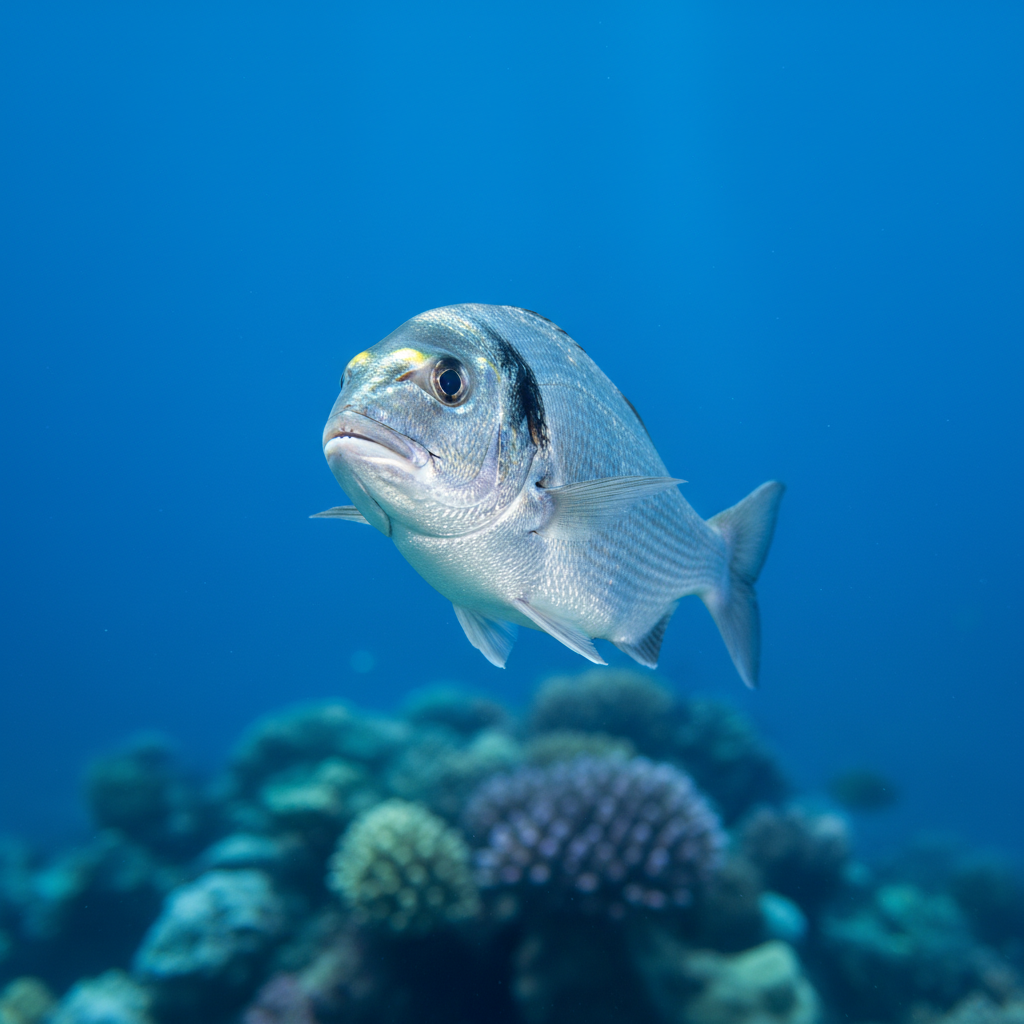
Common Two-Banded Seabream
Group IUCN · Least Concern (LC)

Common Two-Banded Seabream

Diplodus vulgaris, (Geoffroy Saint-Hilaire, 1817)

marine
Where to see it

About Common Two-Banded Seabream

Diplodus vulgaris, the common two-banded sea bream, is a species of marine ray-finned fish belonging to the family Sparidae, which includes the seabreams and porgies. This species is found in the northeastern Atlantic Ocean and the Mediterranean. It is an important species for fisheries and is grown in aquaculture.

Appearance

Diplodus vulgaris has an oval shaped, deep, compressed body with a moderately fleshy-lipped slightly protrusible mouth. There are 8 slender brown coloured incisor-like teeth at the front of each jaw with between 3 and 5 rows of molar-like teeth in the upper jaw and between2 and 4 rows of similar teeth in the lower jaw. The molar like teeth sit behind the incisor-like teeth and extend along the sides of each jaw. The dorsal fin is supported by 11 or 12 spines and between 13 and 16 soft rays while there are 3 spines and 12 to 15 soft rays supporting the anal fin. The overall colour is grey, greenish or brownish, paler on the lower body. There is a dark band on the nape which extends to the base of the pectoral fins and to the rear edge of the gill cover, a second dark band rings the caudal peduncle immediately behind the rearmost soft rays of the dorsal and anal fins.
Habitat

Diplodus vulgaris is found in the northeastern Atlantic Ocean from the Canary Islands and Madeira north to the Bay of Biscay and throughout the Mediterranean and Black Sea. In the Bay of Biscay the species has been spreading north and is now found as far north as the Channel Islands and Normandy. The common two-banded seabream is an oceanodromous, euryhaline, benthopelagic fish found at depths between 0 and 160 m (0 and 525 ft), although typically found in water less than 50 m (160 ft) deep, over rocky and sandy substrates. The young fishes may be found living among seagrass beds.

Humans & conservation

Diplodus vulgaris is subjected to semi-industrial fishing in some parts of the Mediterranean such as Sicily, the Adriatic Sea and Egypt whereas in other areas it is mainly targeted by artisanal fisheries, as well as recreational fisheries. The species is widely available in markets across the Mediterranean and is sold fresh or frozen or salted, despite the flesh not being all that well regarded. The fish are caught in traps in the Canaries with nets and lines used throughout its range, as well as spearing. Diplodus seabreams are very important in Portugal where their combined landings are 13th in importance and 1th in commercial value. The common two-banded seabream is also a potential species for growing in aquaculture as it is euryhaline and attains maturity without the need for hormone treatments,=.

Where to see it

Top-rated dive sites where divers have spotted Common Two-Banded Seabream.

Nissaki

Nissaki

⭐ 4.0 Scout Score
Clear rocky cove, abundant fish, excellent for all levels.
👣 Shore All levels
Seabel Rym Beach

Seabel Rym Beach

⭐ 2.0 Scout Score
Shallow, sandy resort beach ideal for beginners and snorkelers.
👣 Shore Beginner
Blue Hole Gozo

Blue Hole Gozo

⭐ 5.0 Scout Score
Iconic natural blue hole leading to vibrant Coral Gardens.
👣 Shore All levels
Cala della Chiesa

Cala della Chiesa

⭐ 4.0 Scout Score
France, Bonifacio Bouches de Bonifacio Nature Reserve
Picture-perfect shallow snorkel spot with granite blocks and white sand.
🚤 Boat Beginner