
← All marine life
Brassy Trevally
Species IUCN · Least Concern (LC)

Brassy Trevally

Caranx papuensis, Alleyne & MacLeay, 1877

marinebrackish

About Brassy Trevally

The brassy trevally, Caranx papuensis (also known as the brassy kingfish, Papuan trevally, tea-leaf trevally, and green back trevally) is a species of large marine fish classified in the jack family, Carangidae.

Appearance

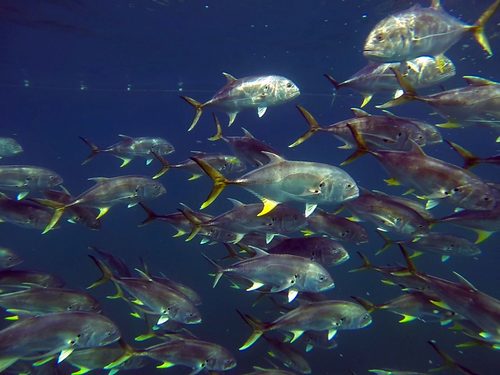
The brassy trevally is a large species of fish, growing to a known maximum of 88 cm in length and 6.4 kg in weight. As its name suggests, the brassy trevally is a brassy to yellow greenish colour dorsally, becoming silvery white on the underside. Juveniles generally lack the brassy tinge, being silver all over. The species' head and body above the lateral line is scattered with small black spots, with few spots occasionally much lower near the pectoral fins. These spots become more numerous with age. The species also has a conspicuous pale silvery-white spot with black margins shoulder near the upper opercle. The fins are yellow to dusky with the exception of the caudal fin, which has a dusky upper lobe and a dusky to yellow lower lobe and distinctive narrow white band on the trailing edge.
Habitat

The brassy trevally is widespread throughout the tropical and subtropical waters of the Indian and West Pacific Oceans. Its range extends from South Africa and Madagascar north along the East African coast, but no records of the species are known from the Red Sea or Persian Gulf. Records resume from India eastward throughout Southeast Asia, the Indonesian Archipelago and numerous Indian Ocean and East Pacific island groups. The species is known from as far south as Sydney, Australia and as far north as the Ryukyu Islands of Japan. Its range extends eastward to the Marquesas Islands in the central Pacific.

Humans & conservation

The brassy trevally is not of high importance to commercial fisheries, often finding its way to market as bycatch in various netting and hook-and-line fisheries. Catch statistics are not kept for the species. The species is of some importance to recreational fishermen, and is considered a good gamefish and is often taken by various fish baits, as well as lures and flies. Despite this, it is rarely targeted by anglers, who overlook it for larger relatives such as giant trevally and bluefin trevally, with the species often being an incidental catch, and rarely kept. The species is also commonly taken by spearfishermen. Brassy trevally is considered to be an excellent table fish. The species has been held in large saltwater aquaria, with studies at the Reunion Island Aquarium reporting the species adjusts to aquarium life, but needs a large tank.

Part of

Where to see it

No dive sites list Brassy Trevally yet. Explore the map to find sites near you.