
← All marine life
Branching Tube Sponge
Species

Branching Tube Sponge

Aiolochroia crassa, (Hyatt, 1875)

marine

About Branching Tube Sponge

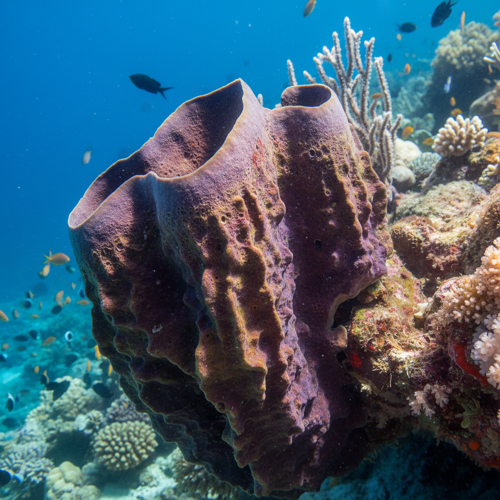
Aiolochroia crassa, also known as branching tube sponge' and bleeding cake sponge, is a colorful sponge species originally described in 1875 by Alpheus Hyatt. Aiolochroia crassa got the name of branching tube sponge due to its large branching tubes.

Appearance

Aiolochroia crassa comes in many different colors and shapes. External colors are normally green, orange, bright yellow, purple or sometimes multiple of these colors. Internally the color of the branching tube sponge is usually yellow. Aiolochroia crassa grows in large cone shaped projections known as "lobes" pointing outward from the base, indicative of its name the branching tube sponge. These projections are normally up to 1 cm apart and about 3-4 mm high. At the top of these projections are Oscules opening about 1-2 cm wide. Aiolochroia crassa has no spicules and is made only of protein spongin fibers. These spongin fibers lead to the sponge be very thick and many have described it to be "cheese like." In fact Aiolochroia crassa has the largest sponging fiber size than any other sponge in the Verongida order.
Habitat

Aiolochroia crassa can be found on reefs over a very large geographic range from South Florida to the Caribbean Sea. They also can be found at numerous depths ranging 3 – 30 meters in depth. In these locations they are commonly found in seagrasses and reefs. They are very dominant in reef environments, especially in the southern and northeast Caribbean where at certain reefs they are the most dominant sponge. Particularly, in inner reef slopes they are especially dominant compared to other reef zones. This dominance has been attributed by some to the defensive properties of the sponge allowing it to have higher fitness.

Diet

Aiolochroia crassa has a very similar diet and feeding style to most Demospongiae. It is a filter feeder which pumps water through with its choanocytes collecting small particles to consume. This sponge family has a POC diet of about 80 percent particulate organic matter and 20 percent microscopically resolvable particulate material.

Part of

Where to see it

No dive sites list Branching Tube Sponge yet. Explore the map to find sites near you.