
← All marine life
Bluelined Grouper
Species IUCN · Least Concern (LC)

Bluelined Grouper

Cephalopholis formosa, (Shaw, 1812)

marine

About Bluelined Grouper

Cephalopholis formosa, the Bluelined hind or bluelined rockcod is a species of marine ray-finned fish, a grouper from the subfamily Epinephelinae which is in the family Serranidae which also includes the anthias and sea basses. It is found in the Indo-Pacific where it is associated with reefs. It is sometimes found in the aquarium trade.

Appearance

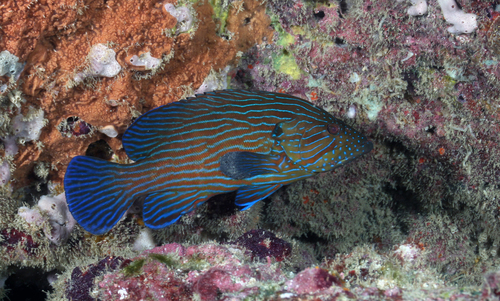
Cephalopholis formosa has a body which is between two and a half to just under three times as long as it is deep. It has a rounded, finely serrated preopercle rounded which has a fleshy lower edge. There are 47 to 51 in the lateral line There are 9 spines and 15-17 soft rays in the dorsal fin while the anal fin has 3 spines and 7-8 soft rays. The caudal fin is rounded. The scales on the body, including the abdomen, are ctenoid. The body is dark brown to yellowish brown in color with thin blue stripes. There are small black and blue spots on the lips, snout, lower part of the head and the chest. They attain a maximum total length of 34 centimetres (13 in).

Habitat

Cephalopholis formosa is found in the shallow, coastal waters of the continent and continental islands of the eastern Indian Ocean and the Western Pacific Ocean; the only oceanic islands where it is found are the Lakshadweep Islands. It is found from the Lakshadweeps and Sri Lanka east to the Philippines. It extends as far north as Honshu in Japan and south to Australia, where it has been recorded only from the Northwest Shelf of Western Australia.

It has also been recorded in the Persian Gulf. Records from the Mascarenes are probably misidentifications of Cephalolophis polleni while those from the Great Barrier Reef probably refer to C. boenak. It may have been introduced outside of its native range due to escapes or releases from aquaria.

Part of

Where to see it

No dive sites list Bluelined Grouper yet. Explore the map to find sites near you.