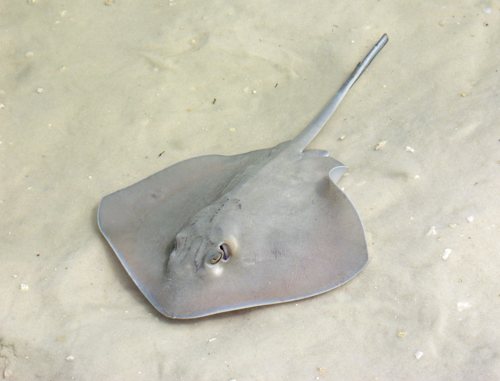
← All marine life
Blackspotted Stingray
Species IUCN · Vulnerable (VU)

Blackspotted Stingray

Taeniura meyeni, (Müller & Henle, 1841)

marine

About Blackspotted Stingray

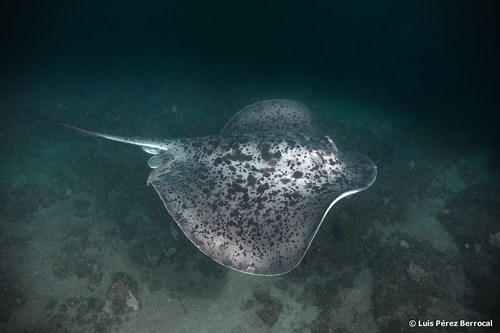
The round ribbontail ray, blotched fantail ray, marble ray, or marbled ray (Taeniurops meyeni) is a species of stingray in the family Dasyatidae, found throughout the nearshore waters of the tropical Indo-Pacific, as well as off islands in the eastern Pacific. It is a bottom-dwelling inhabitant of lagoons, estuaries, and reefs, generally at a depth of 20–60 m (66–197 ft). Reaching 1.8 m (5.9 ft) across, this large ray is characterized by a thick, rounded pectoral fin disc covered by small tubercles on top, and a relatively short tail bearing a deep ventral fin fold. In addition, it has a variable but distinctive light and dark mottled pattern on its upper surface, and a black tail.

Generally nocturnal, the round ribbontail ray can be solitary or gregarious, and is an active predator of small, benthic molluscs, crustaceans, and bony fishes. It is aplacental viviparous, with the embryos sustained by yolk, and later histotroph ("uterine milk") secreted by the mother; up to seven pups are born at a time. Although not aggressive, if provoked the round ribbontail ray will defend itself with its venomous tail spine, and it has been responsible for at least one fatality. It is valued by ecotourist divers and recreational anglers. This slow-reproducing species is threatened by commercial fishing, both targeted and bycatch, and habitat degradation across much of its range. As a result, the International Union for Conservation of Nature (IUCN) has assessed it as Vulnerable.

Appearance

The round ribbontail ray has a thick pectoral fin disc wider than it is long, with a smoothly rounded outer margin. The eyes are of medium size and are followed by larger spiracles. There is a short and broad curtain of skin between the oval nostrils, with a finely fringed trailing margin. The mouth is wide and curved, with faint furrows at the corners. There is a row of seven papillae on the floor, with the outermost pair smaller and set apart from the others. There are 37–46 tooth rows in the upper jaw and 39–45 tooth rows in the lower jaw. The teeth are small with a deep groove across the crown and are arranged in a dense quincunx pattern into flattened surfaces.

Habitat

The round ribbontail ray has a wide distribution in the Indo-Pacific region: it is found from KwaZulu-Natal in South Africa northward along the East African coast to the Red Sea, including Madagascar and the Mascarenes; from there, its range extends eastward through the Indian subcontinent to Southeast Asia and Micronesia, occurring as far north as Korea and southern Japan, and as far south as Australia, where it is found from at least Ningaloo Reef off Western Australia to Stradbroke Island off Queensland, including Lord Howe Island. In the easternmost portion of its range, it has been reported from Cocos Island and the Galápagos Islands, with individuals possibly dispersing as far as Central America.

Behaviour

The round ribbontail ray has nocturnal habits and rests motionless for much of the day, often near vertical structures, in caves, or under ledges. It may be solitary, or form small to large groups. This ray is frequently shadowed by one or more jacks or cobia (Rachycentron canadum); these smaller fishes may feed on food stirred up by the ray's activities, or use the ray's body as cover for approaching their own prey. The round ribbontail ray hunts for bivalves, crabs, shrimps, and small bony fishes on the bottom. When feeding, it adopts a characteristic posture in which it presses the margin of its disc against the bottom and takes in water through its spiracles, which it blows through its mouth to uncover prey buried in the sediment. This species may fall prey to larger fishes such as sharks, and marine mammals.

Humans & conservation

The round ribbontail ray is not aggressive and has been known to approach and investigate divers. However, if harassed it can inflict a severe wound with its venomous tail spine. This species has been responsible for at least one recorded fatality of a diver who was stabbed while attempting to ride the ray. The round ribbontail ray is popular with ecotourist divers because of its size and spectacular appearance.

Part of

Where to see it

No dive sites list Blackspotted Stingray yet. Explore the map to find sites near you.