
← All marine life
Black Trevally
Species IUCN · Least Concern (LC)

Black Trevally

Caranx lugubris, Poey, 1860

marine

About Black Trevally

Caranx lugubris, the black jack, black trevally, black kingfish, coal fish or black ulua, is a species of large ocean fish in the jack family Carangidae. The species has a circumtropical distribution, found in oceanic, offshore waters of the tropical zones of the Pacific, Atlantic and Indian Oceans. The species is particularly prevalent around offshore islands such as the Caribbean islands in the Atlantic, Hawaii and French Polynesia in the Pacific and the Seychelles and Maldives in the Indian Ocean. Black jack are rare in shallow waters, preferring deep reefs, ledges and seamounts in clear waters. The species is easily distinguished by its black to grey fins and jet black scutes, with the head having a steep profile near the snout. The largest recorded length is 1 m and weight of 17.9 kg. The black jack lives either individually or in small schools, and is known to school with other species. It is a predatory fish, taking a variety of fish, crustaceans and molluscs as prey. Sexual maturity is reached at 34.6 cm in females and 38.2 cm in males, with spawning taking place between February and September in the Caribbean. The early life history of the species is very poorly understood. Black jack are of high importance to many island fisheries, but are rarely encountered in most continental fisheries. The species has a reputation as a gamefish, and is variably considered a terrible or excellent food fish, although several cases of ciguatera poisoning have been attributed to the species.

Appearance

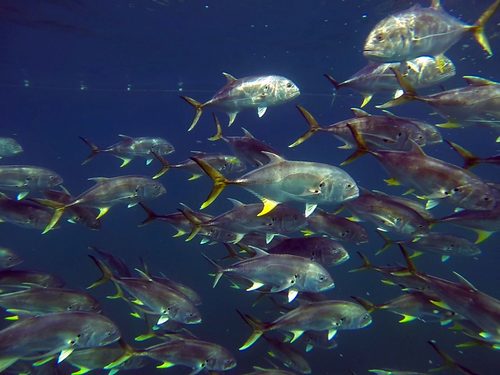
The black jack is a large fish, and is confidently known to grow to a length of 1 m and a weight of 17.9 kg, although is more common at lengths under 70 cm. At least one source asserts a fish of 2.21 m has been reported, which if true would make the black jack the second largest species of carangid behind the yellowtail amberjack (2.5 m). The black jack has a similar overall body shape to the other members of Caranx, having an oblong, compressed form, with the dorsal profile more convex than the ventral profile. This convexity is most pronounced at the head, which slopes steeply downwards, giving the head profile a very angular appearance. The profile between the snout and the nape is concave, with this indent centered near the nostrils. The mouth is fairly large compared to other members of its genus and the maxilla extends to under the centre of the fish's eye.
Habitat

The black jack has a circumtropical distribution, meaning their range extends around the Earth's equatorial oceans, thereby inhabiting the tropical and subtropical regions of the Atlantic, Pacific and Indian Oceans. In the Indian Ocean, they are found from Natal, South Africa in the west to northern Australia in the east. They are patchily distributed along the east African and Asian coastline in the Indian Ocean, being absent from both the Persian Gulf and Red Sea, as well as several countries bordering the ocean. The species is widely known from many Indian Ocean islands including the Seychelles, Réunion, Mauritius and Cargados Carajos In the Pacific Ocean, the black jack is known from parts of the Indonesian-Australian archipelago north to Japan, and through many of the Pacific Islands such as Hawaii, New Caledonia and Tonga.

Behaviour

The black jack lives both in solitude and in schools of up to 30 individuals. Like several other jacks, black jack are able to coordinate these aggregations over coral reefs based on the release of dimethylsulfoniopropionate (DMSP) from the reef. DMSP is a naturally occurring chemical produced by marine algae and to a lesser extent corals and their symbiotic zooxanthellae. In the Atlantic the species has also been video-recorded schooling with the almaco jack, Seriola rivoliana, and the greater amberjack, Seriola dumerili. The diet of the species has been reported on two occasions; once from Easter Island in the south Pacific, where the diet consisted mainly of fish and crustaceans including stomatopods and isopods; and from Brazil, where a variety of fish, crustaceans and molluscs were taken.

Humans & conservation

The black jack is of moderate to high importance to commercial fisheries throughout its range, often being the most abundant large carangid in offshore island catches. The species is taken by both various nets and traps as well as by hook and line. Black jack are usually marketed as fresh, whole fish, but they are also sold salted or dried. The species rarity in most areas means it is not a major target for anglers, however some offshore locations such as the Bahamas the black jack is an important gamefish. The species appeal as a food fish varies between location, with some regions considering it the best table fish available. Despite this, numerous ciguatera poisoning cases have been attributed to the black jack, with laboratory tests confirming the presence of the toxin in the species flesh.

Part of

Where to see it

No dive sites list Black Trevally yet. Explore the map to find sites near you.