
← All marine life
Black Stingray
Species IUCN · Vulnerable (VU)

Black Stingray

Bathytoshia lata, (Garman, 1880)

marine

About Black Stingray

The broad stingray (Bathytoshia lata), also known as the brown stingray or Hawaiian stingray, is a species of stingray in the family Dasyatidae. They range across the Indo-Pacific from southern Africa to Hawaii, and are the predominant species of stingray in the inshore waters of the Hawaiian Islands. This benthic fish also inhabits sandy or muddy flats at depths greater than 15 m (49 ft) in the Eastern Atlantic, from southern France to Angola, including the Mediterranean Sea. Usually growing to 1 m (3 ft) across, the broad stingray has a wide, diamond-shaped pectoral fin disc with a protruding snout tip and a long tail with a ventral fin fold. At night, this species actively forages for bottom-dwelling invertebrates and bony fishes, often near the boundaries of reefs. Reproduction is aplacental viviparous. As substantial threats to its population exist in many areas of its wide distribution, IUCN has listed this species as Vulnerable.

Appearance

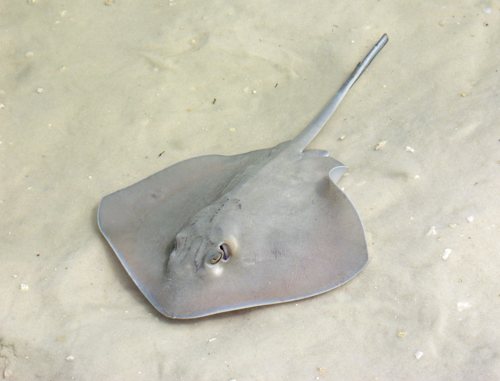
The broad stingray has a diamond-shaped pectoral fin disc a fourth wider than long, with nearly straight leading margins that converge at an obtuse angle, and curved trailing margins. The tip of the snout is rounded and protrudes past the disc. The mouth is arched and contains five or six papillae on the floor, two of which are in front of the others. The pelvic fins are short and rounded. The whip-like tail is twice or more the length of the disc, and bears a serrated stinging spine on the upper surface near the tail base. A long, narrow fin fold occurs beneath the tail, which eventually becomes a keel that runs all the way to the tail tip.
Habitat

Bathytoshia lata occurs in the eastern Atlantic and the Indo-Pacific from southern Africa to the Hawaiian Islands and is also found in the Mediterranean Sea with occasional records from Spain to Turkey.

This species is common in coastal bays with mud or silt bottoms, and may also be encountered in sandy areas or near coral reefs. It is most common at depths between 40–200 m (130–660 ft) but is found as far down as 800 m (2,620 ft).

Behaviour

During the day, the broad stingray is relatively inactive and spends much time lying half-buried on the bottom. A tracking study in Kaneohe Bay found that individuals rays roamed over an average area of 0.83 km2 (0.32 mi2) at night, compared to an average diurnal activity space of 0.12 km2 (0.046 mi2), and did not rest consistently in any particular spot. Rays were most active 2 hours after sunset and before sunrise, and were more active in the higher water temperatures of summer than winter. The behavior of this species was not significantly influenced by tides, likely because they inhabit deeper water.

Humans & conservation

The International Union for the Conservation of Nature formerly assessed the broad stingray as Least Concern, but this was upgraded to Vulnerable in 2021 as it is not known what part of its range overlaps with marine protected areas. This species has become a popular subject for display at public aquariums and resorts.

Part of

Where to see it

No dive sites list Black Stingray yet. Explore the map to find sites near you.