
← All marine life
Bearded Seal
Species IUCN · Near Threatened (NT)

Bearded Seal

Erignathus barbatus, (Erxleben, 1777)

marine

About Bearded Seal

The bearded seal (Erignathus barbatus), also known as the square-flipper seal, is a medium-sized pinniped that is found in and near to the Arctic Ocean. It gets its generic name from two Greek words (eri and gnathos) that refer to its heavy jaw. The other part of its Linnaean name means bearded and refers to its most characteristic feature, the conspicuous and abundant whiskers. When dry, these whiskers curl elegantly, giving the bearded seal a "raffish" look.

Bearded seals are the largest northern phocid. They have been found to weigh as much as 300 kg (660 lb), with the females being the largest. However, male and female bearded seals are not very dimorphic.

The only member of the genus Erignathus, the bearded seal is unique in that it is intermediate in characteristics between the two subfamilies in the family Phocidae: Phocinae and Monachinae.

Fossils first described in 2002 indicate that, during the Pleistocene epoch, bearded seals ranged as far south as South Carolina.

Appearance

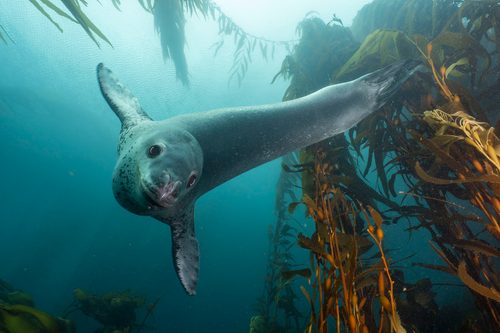
Distinguishing features of this earless seal include square fore flippers and thick bristles on its muzzle. Adults are greyish-brown in colour, darker on the back, rarely with a few faint spots on the back or dark spots on the sides. Occasionally the face and neck are reddish brown. Bearded seal pups are born with a greyish-brown natal fur with scattered patches of white on the back and head. The bearded seal is unique in the subfamily Phocinae in having two pairs of teats, a feature it shares with monk seals.

Bearded seals reach about 2.1 to 2.7 m (6.9 to 8.9 ft) in nose-to-tail length and from 200 to 430 kg (441 to 948 lb) in weight. The female seal is larger than the male. The body fat content of a bearded seal is about 25–40%.
Habitat

Bearded seals are extant in Arctic and Subarctic regions. In the Pacific region, they extend from the Chukchi Sea in the Arctic south into the Bering Sea where they span from Bristol Bay on the Alaskan coast to the Sea of Okhotsk on the Russian coast, up to but not including the northern coast of Japan. In the Arctic Ocean, they are found along the northern coasts of Russia, Norway, Canada, and Alaska, including the Norwegian archipelago of Svalbard and Canadian Arctic Archipelago. In the Atlantic, bearded seals are found along the northern coast of Iceland, the east and west coasts of Greenland and the Canadian mainland as far south as Labrador.

Although the range typically only extends down into Subarctic areas, bearded seals have been seen in Japan and China, as well as far south of their range in Germany, Netherlands, United Kingdom, France, Spain and Portugal.

Diet

Primarily benthic, bearded seals feed on a variety of small prey found along the ocean floor, including clams, squid, crustaceans, and fish. Their whiskers serve as feelers in the soft bottom sediments. Adults favor shallow coastal areas no more than 300 m (980 ft) deep. Pups up to one year old, however, will dive as deep as 450 m (1,480 ft). Flatfishes (such as American plaice), sculpins, and Arctic cod made up most of their summer diet. Sculpin were found to be the largest fish consumed by the seals. The seals also feed in summer on invertebrates such as anemones, sea cucumbers, and polychaete worms. Bearded seals are capable of preying on pelagic and demersal fish in addition to their benthic prey.

Behaviour

Bearded seals, along with ringed seals, are a major food source for polar bears. Typically pups up to around the age of 2 years are attacked, often as newborns within their birthing lairs, leaving older juveniles and adults commonly unharmed. Killer whales also prey on these seals, sometimes overturning ice floes to reach them. Walruses may eat these seals, mainly pups, but such predation is rare.

Reproduction

Bearded seals give birth in the spring. In the Canadian Arctic, seal pupping occurs in May. In Svalbard, bearded seals reach sexual maturity at 5 or 6 years of age. Further south, in Alaska, most pups are born in late April. Pups are born on small drifting ice floes in shallow waters, usually weighing around 30–40 kg (66–88 lb). They enter the water only hours after they are born, and quickly become proficient divers. Mothers care for the pups for 18–24 days, during which time the pups grow at an average rate of 3.3 kg (7.3 lb) per day. During this time, pups consume an average of 8 L (1.8 imp gal; 2.1 US gal) of milk a day. By the time they are weaned, the pups have grown to about 100 kg (220 lb).

Humans & conservation

On March 28, 2008, the U.S. National Marine Fisheries Service initiated a status review under the Endangered Species Act (ESA) to determine if listing this species under the ESA is warranted. The bearded seal is protected under the Marine Mammal Protection Act, and in October 2025 the IUCN reclassified it from "least concern" for extinction to near threatened, citing the loss of the sea ice on which Arctic seals breed and raise their pups. NOAA determined that the factors influencing any change in conservancy status of the bearded seal may include loss of sea ice by climate change, bycatch from commercial fishing gear, and hunting. Due to climate change, factors such as loss of sea ice, as well as decrease in prey population may create negative results on the bearded seal population in the future.

Part of

Where to see it

No dive sites list Bearded Seal yet. Explore the map to find sites near you.