
← All marine life
Bar Jack
Species IUCN · Least Concern (LC)

Bar Jack

Caranx ruber, (Bloch, 1793)

marine

About Bar Jack

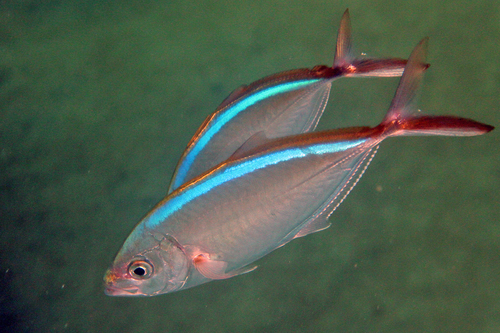
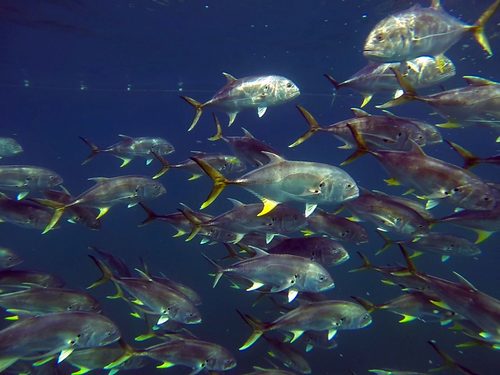
The bar jack (Caranx ruber), also known as the carbonero, cojinúa, red jack, blue-striped cavalla or passing jack, is a common species of inshore marine fish classified in the jack family, Carangidae. The bar jack is distributed through the western Atlantic Ocean from New Jersey and Bermuda in the north to Venezuela and possibly Brazil in the south, with the largest population in the Gulf of Mexico and West Indies. The bar jack is most easily distinguished from similar jacks by the dark horizontal bar which runs along the back and down the caudal fin. It is often accompanied by an electric blue stripe immediately below. Other more detailed differences include dentition and soft ray counts. The bar jack is a moderately large species, growing to a recorded maximum of 65 cm (26 in) and a weight of 6.8 kg (15 lb). The species inhabits clear shallow waters, often over coral reefs where it lives either solitarily or in large schools, taking various fishes, crustaceans and cephalopods as prey. Studies in Cuba indicate spawning occurs between March and August, with sexual maturity reached at 26 cm. It is a relatively popular sport fish and can be caught on light tackle with a variety of lures and baits. It is considered to be a good food fish, however many recorded ciguatera cases are attributed to the species, with most cases reported on the island of St. Thomas traced to this single species.

Appearance

The bar jack is a moderately large species, growing to a recorded maximum length of 69 cm (27 in), and a weight of 6.8 kg (15 lb), but is commonly encountered at lengths of less than 40 cm (16 in). The bar jack displays the typical body shape of most of the jacks, having an elongate, moderately deep and compressed form, with dorsal and ventral profiles of approximately equal convexity. The dorsal fin is divided into two sections, the first consisting of 8 spines while the second has 1 spine followed by 26 to 30 soft rays. The anal fin is composed of 2 anteriorly detached spines followed by 1 spine and 23 to 26 soft rays, with both the anal and soft dorsal fin lobes being slightly elongated. The pectoral fins are falcate and longer than the head, consisting of 19 to 21 soft rays.
Habitat

The bar jack is widely distributed throughout the tropical and subtropical waters of the western Atlantic Ocean, and is a common species throughout most of its range. The northernmost limit of its range is New Jersey in the northern United States, with its range extending south along the continental coast to Venezuela. It inhabits a number of offshore islands and archipelagos including Bermuda, as well as the West Indies. The bar jack is most abundant in the Gulf of Mexico, the West Indies and Caribbean, but in the Gulf of Mexico is limited to offshore waters. There have been reliable reports of the species from Rio de Janeiro in Brazil and far offshore at Saint Helena in the south central Atlantic, which would extend the species southern limit significantly if correct.

Diet

The bar jack is a benthopelagic predator, taking its prey both in midwater and along the seafloor. The diet consists mostly of fish, up to 90% of the fish's intake in some studies, with planktonic crustaceans and small cephalopods taken in minor volumes. There is significant change in diet with age in fish studied off Cuba, which may reduce intraspecific competition in the species. Young fish prefer planktonic organisms, predominantly decapod and fish larvae; fish reaching sexual maturity prey on shrimp and small fish, while mature fish feed almost exclusively on small fish. The fish species preferred by bar jack appear to be mostly small sand dwellers such as blennies and gobies or small reef dwellers including wrasses, butterflyfish and filefish, with the diet of the latter leading to the accumulation of coral derived ciguatera toxin in the jack's flesh.

Reproduction

The bar jack spawns twice each year, with this timing related to seasonal changes as described previously. During the peak feeding periods, the fish accumulate body fat in preparation for spawning, which occurs through the period from March to August in Cuba, with peaks during March–April and June–July.

Fish congregate in schools of hundreds to spawn, with pairs of fish breaking away to spawn. Studies have found between 67,000 and 231,000 eggs are released by each female, with fertilisation occurring externally. The eggs are pelagic and around 0.75 mm to 0.85 mm in diameter, hatching when the larvae are around 2 mm in length, and flexion occurs at 4–5 mm. The larval stage of the bar jack has been extensively described by Richards (2006). Larvae appear between April and October in the Gulf Stream current, and grow the fastest during their first three years of life.

Humans & conservation

The bar jack is of minor to intermediate importance to fisheries through its range; both commercially and to recreational fishermen. Archaeological evidence from San Salvador Island in the Bahamas demonstrates this species has long been targeted by humans for food, with the native Indians of the region often taking the bar jack for consumption, although it was of lesser importance than reef fishes such as parrotfishes and groupers. Modern fisheries take considerable quantities of the fish, but it rarely makes up the bulk of the catch. Catch statistics are not available for most countries. The United States reports only a small catch of between 0 and 15 tonnes per year, but with the abundance of the species in the Caribbean, larger catches are made here. The bar jack is somewhat shy of baited hooks and is therefore taken predominantly by trawls and seines.

Part of

Where to see it

No dive sites list Bar Jack yet. Explore the map to find sites near you.