
← All marine life
Australian Sea Lion
Species IUCN · Endangered (EN)

Australian Sea Lion

Neophoca cinerea, (Péron, 1816)

marine

About Australian Sea Lion

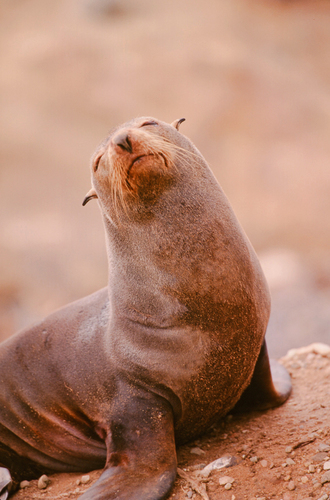
The Australian sea lion (Neophoca cinerea), also known as the Australian sea-lion or Australian sealion, is a species of sea lion that is the only endemic pinniped in Australia. It is currently monotypic in the genus Neophoca, with the extinct Pleistocene New Zealand sea lion Neophoca palatina the only known congener. With a population estimated at 14,730 animals, the Wildlife Conservation Act of Western Australia (1950) has listed them as "in need of special protection". Their conservation status is listed as endangered. These pinnipeds are specifically known for their abnormal breeding cycles, which are varied between a 5-month breeding cycle and a 17-18-month aseasonal breeding cycle, compared to other pinnipeds, which fit into a 12-month reproductive cycle. Females are either silver or fawn with a cream underbelly, and males are dark brown with a yellow mane and are bigger than the females.

Habitat

Australian sea lions are sparsely distributed across their range, from the Houtman Abrolhos Islands (28°S, 114°E) in Western Australia, along the southern Australian coast to The Pages Islands (35°46'S, 138°18'E) in South Australia. Sixty-six breeding colonies have been identified, with 28 in Western Australia and 38 in South Australia.

Most breeding colonies exist on offshore islands, with the exception of Point Labatt in South Australia, Baxter Cliffs (west of Twilight Cove) in Western Australia, and the Bunda Cliffs, Great Australian Bight, which straddles the border between the two states. About 42% of the total known population is found within the three largest colonies east of Port Lincoln; Seal Bay (on Kangaroo Island's south coast), The Pages, and Dangerous Reef (in Spencer Gulf).
Diet

Australian sea lions have been described as opportunistic, benthic foragers. Limited stomach-content and faecal analyses have identified a wide variety of prey in the diet of the Australian sea lion, including teleost fish (including blue-throated wrasse and whiting), squid, cuttlefish, octopus, sharks (including Port Jackson sharks), rays, southern rock lobster, other small crustaceans, and little penguins. Regurgitate and stomach samples from Australian sea lions at Seal Bay contained hard parts consisting predominantly of benthic taxa. This supports previous evidence that this species forages primarily on neritic, benthic prey, many of which are nonmigratory. For the cephalopod component of the Australian sea lion diet, octopus and giant Australian cuttlefish made up the greatest biomass of prey taxa.

Behaviour

As of 2020, 66 breeding colonies have been identified: 28 in Western Australia and 38 in South Australia. The animals breed on at least 50 islands, 27 in Western Australia and 23 in Southern Australia. Prior to a study that took place from 1987 to 1992, 31 of the 50 island breeding sites had not been previously reported, and 19 more islands were considered potential breeding grounds. On the basis of surveys conducted primarily in 1990, about 70% of the population was in Southern Australia and 30% in Western Australia. Pup production was estimated at 2,432 for these 50 islands in 1990. In 1994 and 1995 another 10 breeding colonies were recorded on the mainland in the Great Australian Bight region, only producing 161 pups. Reproduction is yielding fewer and fewer pups per breeding season.

Reproduction

Some zoos and aquaria are participating in captive-breeding programs. In 2006, at least 41 pups reportedly had been born and raised in captivity since 1981. The species has been kept in aquaria since at least as early as 1965.

In 2015, an Australian sea lion juvenile was captured at Bletchley, near Strathalbyn, which is located on the River Angas at the southeastern edge of the Adelaide Hills and beginning of the Fleurieu Peninsula. The animal was going to be considered for holding in captivity.

Humans & conservation

Australian sea lions should only be approached in the company of a park ranger. They may exhibit defensive behavior, including biting. Sea lions have historically been captured from the wild and held in captivity in various zoos and aquaria, including Marineland of South Australia.

Part of

Where to see it

No dive sites list Australian Sea Lion yet. Explore the map to find sites near you.