
← All marine life
Antarctic Minke Whale
Species IUCN · Near Threatened (NT)

Antarctic Minke Whale

Balaenoptera bonaerensis, Burmeister, 1867

marine

About Antarctic Minke Whale

The Antarctic minke whale or southern minke whale (Balaenoptera bonaerensis) is a species of minke whale within the suborder of baleen whales. It is the second smallest rorqual after the common minke whale and the third smallest baleen whale. Although first scientifically described in the mid-19th century, it was not recognized as a distinct species until the 1990s. Once ignored by the whaling industry due to its small size and low oil yield, the Antarctic minke was able to avoid the fate of other baleen whales and maintained a large population into the 21st century, numbering in the hundreds of thousands. Surviving to become the most abundant baleen whale in the world, it is now one of the mainstays of the industry alongside its cosmopolitan counterpart the common minke. It is primarily restricted to the Southern Hemisphere (although vagrants have been reported in the North Atlantic) and feeds mainly on euphausiids.

Appearance

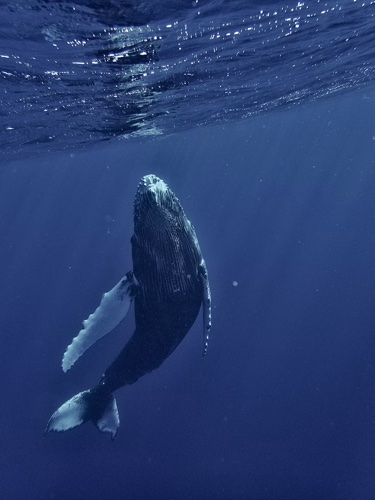
The Antarctic minke is among the smallest of the baleen whales, with only the common minke and the pygmy right whale being smaller. The longest caught off Brazil were an 11.9 m (39.0 ft) female taken in 1969 and an 11.27 m (37.0 ft) male taken in 1975, the former four feet longer than the second longest females and the latter five feet longer than the second longest males. Off South Africa, the longest measured were a 10.66 m (35.0 ft) female and a 9.75 m (32.0 ft) male. The heaviest caught in the Antarctic were a 9 m (29.5 ft) female that weighed 10.4 metric tons (11.5 short tons) and an 8.4 m (27.6 ft) male that weighed 8.8 metric tons (9.7 short tons). At physical maturity, females average 8.9 m (29.2 ft) and males 8.6 m (28.2 ft). At sexual maturity, females average 7.59 m (24.9 ft) and males 8.11 m (26.6 ft). Calves are estimated to be 2.74 m (9 ft) at birth.
Habitat

Antarctic minke whales occur throughout much of the Southern Hemisphere. Some may even cross the equator into the Northern Hemisphere. In the western South Atlantic, they have been recorded off Brazil from 0°53'N to 27°35'S (nearly year-round), Uruguay, off central Patagonia in Argentina (November–December), and in the Strait of Magellan and Beagle Channel of southern Chile (February–March), while in the eastern South Atlantic they have been recorded in the Gulf of Guinea off Togo, off Angola, Namibia (February), and Cape Province, South Africa. In the Indian and Pacific Oceans, they have been recorded off Natal Province, South Africa, Réunion (July), Australia (July–August), New Zealand, New Caledonia (June), Ecuador (2°S, October), Peru (12°30'S, September–October), and the northern fjords of southern Chile.

Diet

Antarctic minke whales are the main prey item of Type A killer whales in the Southern Ocean. Their remains have been found in the stomachs of killer whales caught by the Soviets, while individuals caught by the Japanese exhibited damaged flippers with tooth rake scars and parallel scarring on the body suggestive of killer whale attacks. Large groups of killer whales have also been observed chasing, attacking, and even killing Antarctic minke whales. Most attacks involve Type A killer whales, but on one occasion, in January 2009, a group of ten Type B or pack ice killer whales, which normally preyed on Weddell seals in the area by wave-washing them off ice floes, were observed to attack, kill, and feed on a juvenile Antarctic minke whale in Laubeuf Fjord, between Adelaide Island and the Antarctic Peninsula.

Behaviour

Antarctic minke whales are more gregarious than their smaller counterparts, the common and dwarf minke whale. The average group size in the Antarctic was about 2.4 (adjusted downwards for observer bias), with about a quarter of the sightings consisting of singles and one-fifth of pairs; the largest aggregation consisted of 60 individuals. Off South Africa, the average group size was about two, with singles (nearly 46%) and pairs (31%) being the most common – the largest was 15. Off Brazil, most sightings were of singles (32.6%) or pairs (31.5%), with the largest group consisting of 17 individuals.

Humans & conservation

The Antarctic minke whale is listed as near threatened on the IUCN Red List. However, the IUCN states that the population size is "clearly in the hundreds of thousands".

The Antarctic minke whale is listed on Appendix II of the Convention on the Conservation of Migratory Species of Wild Animals (CMS). It is listed on Appendix II as it has an unfavourable conservation status or would benefit significantly from international co-operation organised by tailored agreements.

In addition, the Antarctic minke whale is covered by the Memorandum of Understanding for the Conservation of Cetaceans and Their Habitats in the Pacific Islands Region.

Part of

Where to see it

No dive sites list Antarctic Minke Whale yet. Explore the map to find sites near you.