
← All marine life
Antarctic Fur Seal
Species IUCN · Endangered (EN)

Antarctic Fur Seal

Arctocephalus gazella, (Peters, 1875)

marine

About Antarctic Fur Seal

The Antarctic fur seal (Arctocephalus gazella) is one of eight seals in the genus Arctocephalus, and one of nine fur seals in the subfamily Arctocephalinae.

Despite what its name suggests, the Antarctic fur seal is mostly distributed in Subantarctic islands and its scientific name is thought to have come from the German vessel SMS Gazelle, which was the first to collect specimens of this species from the Kerguelen Islands.

Appearance

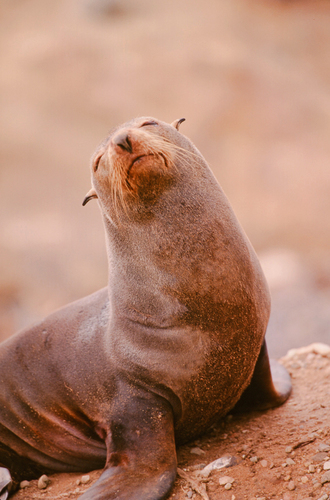
The fur seal is a midsized pinniped with a relatively long neck and pointed muzzle compared with others in the family. The nose does not extend much past the mouth, the external ears are long, prominent, and naked at the tip. Adults have very long vibrissae, particularly males, up to 35 to 50 cm. The fore flippers are about one-third, and hind flippers slightly more than one-fourth of the total length.

Adult males are dark brown in colour. Females and juveniles tend to be paler, almost grey with lighter undersides. Colour patterns are highly variable, and scientists reported that some hybridization between Subantarctic and Antarctic fur seals has occurred. Pups are dark brown at birth, almost black in color. However, a very small number of partially leucistic Antarctic fur seals have been found.
Habitat

The Antarctic fur seal is one of three fur seal species present in Antarctica and the subantarctic islands, along with the sub-Antarctic fur seal (Arctocephalus tropicalis) and New Zealand fur seal (Arctocephalus forsteri).

Antarctic fur seals are believed to be the most abundant species of fur seal. The largest congregation occurs on the island of South Georgia in the southern Atlantic Ocean, which holds approximately 95% of the global population. The current best estimate of the South Georgia population is between 4.5 and 6.2 million animals. Bouvet Island has the second largest population with 46,834 animals. However, there are regional differences in population trends: some colonies are increasing in size (e.g. Kerguelen Islands, McDonald Islands), some are stable (e.g. Macquarie Island, Heard Islands), and some are showing a decrease (e.g. Bouvet Island).

Diet

Antarctic fur seals feed primarily on krill, fish, and squid. Birds are eaten occasionally outside the breeding season. Nursing mothers near South Georgia are dependent on krill during the breeding season, therefore the availability of krill is important to the reproductive success of this animal. The colonies at Macquarie Island and the Kerguelen Islands rely more on a diet of fish and squid. Antarctic fur seals dive at night to feed.

Behaviour

Antarctic fur seals are one of the better-studied Southern Ocean predators. However, the vast majority of information has been collected during summer breeding months. The breeding system of the Antarctic fur seal is polygynous, and dominant breeding males mate with as many as 20 females during a successful season. Males establish breeding grounds in October to early November. Females generally reach the colonies in December and give birth to a single pup several days later. Gestation lasts from 8 to 9 months and a high breeding synchrony has been observed across the species' range, concentrating 90% of pup births in a 10-day window. Pups are weaned at about four months old. Juveniles may then spend several years at sea before returning to begin their breeding cycles.

Humans & conservation

South Georgia islands, which hold approximately 95% of the global population, had a total population in 1999/2000 between 4.5 and 6.2 million. The South Georgia population reached carrying capacity fairly recently and may thus be spilling over into relatively nearby, lower density sites. However, the abundance of adult females is estimated to have declined by some 30% between 2003 and 2012, and by 24% since 1984 to around 550,000. The population trend according to the IUCN Red list is 'decreasing' and it has been suggested that this decline is due to the effects of global climate change on prey availability.

Part of

Where to see it

No dive sites list Antarctic Fur Seal yet. Explore the map to find sites near you.