
← All marine life
Adelie Penguin
Species IUCN · Least Concern (LC)

Adelie Penguin

Pygoscelis adeliae, (Hombron & Jacquinot, 1841)

marine

About Adelie Penguin

The Adélie penguin (Pygoscelis adeliae) is a species of penguin common along the entire coast of the Antarctic continent. It is the most widespread penguin species in the Antarctic, and, along with the emperor penguin, is the most southerly distributed of all penguins. It is named after Adélie Land, in turn, named for Adèle Dumont d'Urville, who was married to French explorer Jules Dumont d'Urville, who first discovered this penguin in 1840. Adélie penguins obtain their food by both predation and foraging, with a diet of mainly krill and fish.

Appearance

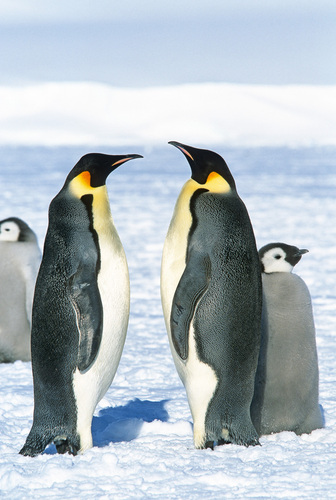
The Adélie penguin is a mid-sized bird, measuring 70–73 cm (28–29 in) in length and weighing 3.8 to 8.2 kg (8.4 to 18.1 lb). Although the sexes look the same, females have shorter wings and beaks and weigh significantly less. The adult is black on the head, throat and upper parts, with snowy white underparts. It has a conspicuous white eye ring around a black iris. The beak is largely covered with black feathers, leaving only the tip exposed; this is primarily black, though it can show indistinct reddish-brown markings. The upper surface of the wing is black with a white trailing edge, while the underside is white with a narrow black leading edge and a small black tip. The legs and feet, which are mostly unfeathered, are pinkish.
Habitat

The Adélie penguin is one of only four penguin species to nest on the continent itself. Breeding colonies are scattered along Antarctica's coasts and on a number of sub-Antarctic islands, including those in the South Orkneys, the South Shetlands, the South Sandwich Islands, the Balleny Islands, Scott Island and South Georgia. The penguins are much less common north of the 60th parallel south but have occurred as vagrants in Australia, New Zealand and southern South America.

Diet

The Adélie penguin is known to feed mainly on Antarctic krill, ice krill, Antarctic silverfish, lanternfish (specifically, the Antarctic lanternfish), amphipods (Themisto gaudichaudii, Cyllopus lucassi, Hyperia and unidentified gammariids), sea krill, glacial squid and other cephalopods (diet varies depending on geographic location) during the chick-rearing season. The stable isotope record of fossil eggshell accumulated in colonies over the last 38,000 years reveals a sudden change from a fish-based diet to krill that began around 200 years ago. This is most likely due to the decline of the Antarctic fur seal since the late 18th century and baleen whales during the early 20th century. The reduction of competition from these predators has resulted in a surplus of krill, which the penguins now exploit as an easier source of food.

Behaviour

Apsley Cherry-Garrard, a survivor of Robert Falcon Scott's ill-fated British Antarctic Expedition of 1910, documented details of penguin behaviour in his book The Worst Journey in the World. "They are extraordinarily like children, these little people of the Antarctic world, either like children or like old men, full of their own importance..." George Murray Levick, a Royal Navy surgeon-lieutenant and scientist who also accompanied Scott, commented on displays of selfishness among the penguins during his surveying in the Antarctic: "At the place where they most often went in [the water], a long terrace of ice about six feet in height ran for some hundreds of yards along the edge of the water, and here, just as on the sea-ice, crowds would stand near the brink.

Reproduction

Adélie penguins breed from October to February. Adélies build rough nests of stones. Two eggs are laid; these are incubated for 32 to 34 days by the parents taking turns (shifts typically last for 12 days). The chicks remain in the nest for 22 days before joining crèches. The chicks moult into their juvenile plumage and go out to sea after 50 to 60 days.

Humans & conservation

Adult Adélie penguins are regularly preyed upon by leopard seals. South polar skuas, in particular, and giant petrels kill many chicks and eat eggs as well. Giant petrels and orcas will occasionally kill adult Adelie penguins. Kelp gulls and snowy sheathbills also prey on chicks and eggs.

In 2024, researchers from Federation University Australia reported more than 532 dead Adélie penguins on Antarctica's Heroína Island, with the H5N1 bird flu suspected as the cause. The virus, having arrived in South America in 2022, poses a risk to Antarctic wildlife. Samples from the deceased penguins are under analysis, and the H5 strain has been detected in local skua seabirds, potentially facilitating further spread. This situation is particularly concerning for the wildlife of the region, which includes an estimated 20 million pairs of penguins and the already climate-threatened emperor penguins.

Part of

Where to see it

No dive sites list Adelie Penguin yet. Explore the map to find sites near you.