
← All marine life
Zoanthid
Group

Zoanthid

Zoantharia, Gray, 1832

marine

About Zoanthid

Zoanthids are an order of hexacorals. They are also often referred to as zoanthiniarians, zoantharians (proper), colonial anemones, button polyps and scientifically as Zoanthiniaria, Zoanthinaria, Zoantharia, Zoanthidea, Zoanthidia, Zoantharida.

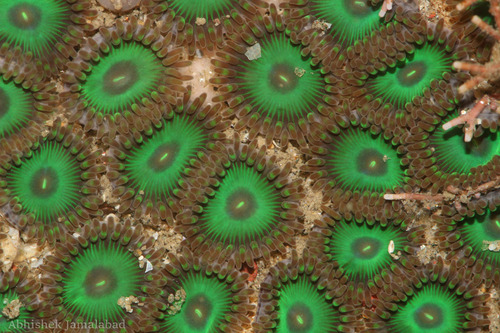
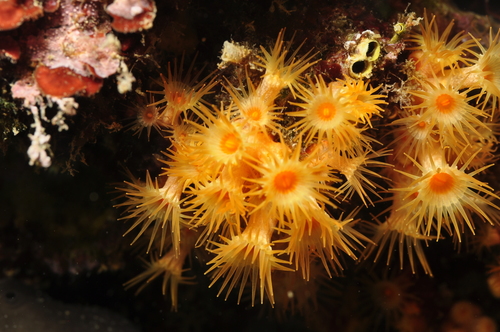
Zoanthids are commonly found in coral reefs, the deep sea and many other marine environments around the world. This includes many tropical and subtropical ecosystems. These animals come in a variety of different colonizing formations and in numerous different colors. They can be found as individual polyps, attached by a fleshy stolon or a mat that can be created from small pieces of sediment, sand and rock. They are known to reproduce asexually and to produce marine toxins. The term "zoanthid" refers to all animals within this order Zoantharia, and should not be confused with "Zoanthus", which is one genus within Zoantharia.

These are among the most commonly collected cnidarians in reef aquaria, as they are easily propagating, very durable in many water conditions, and play a very important role in their natural ecosystems.

Appearance

Zoanthids can be distinguished from other colonial anthozoans and soft coral by their characteristic of incorporating sand and other small pieces of material into their tissue to help make their structure (except for the family Zoanthidae). They also have high morphological plasticity, allowing them to change their relative shape to fit their environment. The order also possesses tentacles that are all marginal, further differentiating them from other marine organisms.

Many zoanthids (in particular the genera Epizoanthus and Parazoanthus) are often found growing on other marine invertebrates, such as reef building coral and sponges, either only on their body or their branches. Most of the species propagate asexually and the offspring of the original polyp remain connected to each other, by a stolonal network or coenosarc. Although, some species are solitary.
Habitat

This order is known to colonize rocky areas (ex. littoral rocky substrate) providing benthic shelter to many invertebrates such as crustaceans, worms, polychaetas, nudibranch, mollusks, etc. They are often labeled as "ecosystem engineers" as they transform habitats' relative diversity and increase species richness as their presence have a correlation to an increase in the number and adaptability of invertebrates in an aquatic ecosystem. However, zoanthids ability to easily colonize and adapt can often negatively impact a habitat's system. Any local disturbance, climate change and ocean acidification negatively impacts and causes the deaths of coral and other species.

Diet

Zoanthids derive their energy requirements through both photosynthesis and predation on other invertebrates. Such zooxanthellate genera have a symbiotic relationship with zooxanthellae, dinoflagellates that act as endozoic algae. These algae conduct photosynthesis within the zoanthid, providing substantial glycine or glycerol to the host, that can then be stored in lipids and proteins, or used in the synthesis of nucleotides and nucleic acids. The number of zooxanthellae can also impact the color of the body, creating additional morphs in certain species. To regulate the number of zooxanthellae, some zoanthids eject the algae; however, the expulsion can also be for dire needs caused by poor environmental conditions. Some zoanthids, like those of the Palythoa genus, also feed on exogenous organisms such as zooplankton, crustaceans, and fish particles.

Reproduction

Most zoanthids reproduce asexually. All zoanthids (except Sphenopus) spawn through budding and propagation within their colonies or clones. The organization of such a process depends on the organization of sex and reproductive organs within the colonies. Some subspecies are gonochoric, meaning that populations will have both females and males, such as the suborder Macronemina. Some subspecies will be hermaphroditic, meaning each individual has both female and male reproductive organs, allowing the individual to control where and how the sperm and oocyte will interact on the septa; an example would be the suborder Brachycnemina.

Humans & conservation

While zoanthids are resistant to environmental change and anthropogenic issues, like all organisms, they have a range of tolerance and limits to what they can adapt to. When some zoanthids are in poor environmental conditions, they often eject most or all the zooxanthellae within them, as their bodies cannot maintain the increasing population as their bodies weaken from the environment. Zoanthids are also currently threatened in intertidal zones due to increasing ocean temperatures, rising sea levels, and radiation from the sun, causing stress in populations. Further research has also demonstrated they are also vulnerable to climate change impacts, pollution of microplastics, increasing number of invasive species, and the spread of disease.

Species in this group

Where to see it

No dive sites list Zoanthid yet. Explore the map to find sites near you.