
← All marine life
Yellowtail Kingfish
Species IUCN · Least Concern (LC)

Yellowtail Kingfish

Seriola lalandi, Valenciennes, 1833

marinebrackish

About Yellowtail Kingfish

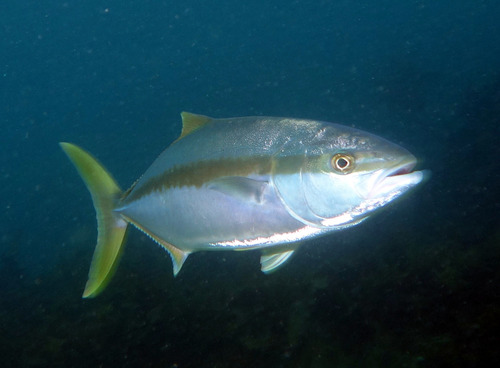
The yellowtail amberjack, yellowtail kingfish, hiramasa or great amberjack (Seriola lalandi) is a large fish found in the oceans of the Southern Hemisphere. Although previously thought to be found in all oceans and seas, recent genetic analysis restricts S. lalandi proper to the Southern Hemisphere waters. However, they are found in Northern Hemisphere waters during certain times of the year. The fish was given its name by Pierre Antoine Delalande, a naturalist who first informed zoologist Achille Valenciennes of the existence of this species. His reason for the use of the word Seriola (feminine diminutive form of seria, a large earthenware pot) to name the fish is uncertain, but the epithet lalandi was derived from his surname.

Habitat

The yellowtail amberjack occurs in tropical and temperate waters of the Southern Hemisphere and the northern Pacific. In Australia, it is recorded from North Reef, Queensland, (23° 11′ S) to Trigg Island, Western Australia, (31° 52′ S), and as far south as Tasmania.

The yellowtail amberjack (or yellowtail kingfish as it is known in Australia) is a highly mobile pelagic species, and tends to either form single-species schools, or combine with southern bluefin tuna (Thunnus maccoyii) and silver trevally (Pseudocaranx dentex). They prefer water temperatures of 17‒24 °C.

In general, they inhabit rocky reefs and adjacent sandy areas in coastal waters and occasionally enter estuaries. They are found from shallow water down to depths around 50 m (160 ft), although have been caught from over 300 m (980 ft).

Diet

Being a pelagic fish, yellowtail amberjack are highly active predators, usually in schools or in pairs. Their main diet consists of baitfish including yellowtail mackerel, squid, prawns, garfish, pilchards and kahawai. Yellowtail amberjacks are one of the major predator species in New Zealand waters, and have been recorded eating seabirds.

Behaviour

Yellowtail amberjacks are known for their curiosity around human vessels. The fish often accompany stingrays in harbours and estuaries, making use of the stingrays ability to sense fish through electroreception.

Part of

Where to see it

No dive sites list Yellowtail Kingfish yet. Explore the map to find sites near you.