
← All marine life
Yellowtail Fusilier
Species IUCN · Least Concern (LC)

Yellowtail Fusilier

Caesio cuning, (Bloch, 1791)

marine

About Yellowtail Fusilier

Caesio cuning, the redbelly yellowtail fusilier, yellowtail fusilier, red-bellied fusilier or robust fusilier, is a species of marine ray-finned fish, a fusilier belonging to the family Caesionidae. It is native to the Indian and Western Pacific Oceans.

Appearance

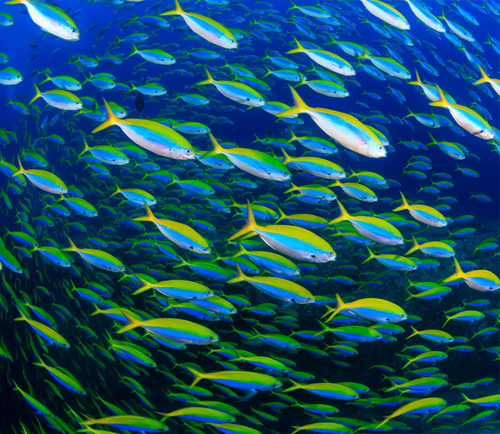
Caesio cuning has a deep and laterally compressed body. The jaws, vomer, and palatines have small conical teeth. The dorsal and anal fins have scales; the dorsal fin has 10 spines and 14 to 16, typically 15, soft rays while the anal fin contains 3 spines and 10 to 12, usually 11, soft rays. The pectoral fins have 17 to 20 fin rays, normally 18 or 19. This species attains a maximum total length of 60 cm (24 in). The rear of the back, the caudal fin and the dorsal surface of the caudal peduncle are yellow. The rest of the upper body is greyish blue. The lower flanks and abdomen are white or pinkish. The pectoral, pelvic, and anal fins are white to pink. The pectoral fin has black on its axil and on the upper part of its base. The dorsal fin is greyish-blue at the front and yellow at the rear.
Habitat

Caesio cuning has an Indo-West Pacific range. It ranges from Sri Lanka and southern India east to Fiji, north to southern Japan and south to northern Australia. It occurs at depths between 1 and 60 m (3 ft 3 in and 196 ft 10 in). It often occurs in silty areas where visibility is poor, otherwise it is found in coastal waters, typically above rocky and coral reefs.

Humans & conservation

Caesio cuning is a moderately important target for coastal fisheries. It is common in fish markets in Indonesia and the Philippines. They are caught using drive-in nets, gill nets, traps, trawls and handlines. The fish caught are normally sold as fresh fish but some of the catch is preserved as salted fish. The juveniles are caught to be used as bait by tuna fisheries. There have been population declines in some areas because of overfishing but in other areas populations are stable.

Part of

Where to see it

No dive sites list Yellowtail Fusilier yet. Explore the map to find sites near you.