
← All marine life
Yellowstriped Cardinalfish
Species IUCN · Least Concern (LC)

Yellowstriped Cardinalfish

Ostorhinchus cyanosoma, (Bleeker, 1853)

marine

About Yellowstriped Cardinalfish

Ostorhinchus cyanosoma, commonly known as the yellow-striped cardinalfish, goldenstriped cardinalfish, or the orange-lined cardinalfish, is a species of marine fish in the cardinalfish family (family Apogonidae) of order Perciformes. It is native to the Indo-West Pacific.

O. cyanosoma is usually a blueish silver color with orange-yellow stripes, and grows to be an average of 6 centimeters. It lives in waters up to 50m in depth, often in lagoons or coral reefs. It is active during the nighttime, feeding on small plants and animals, mostly plankton. It has been the subject of research to test what might happen to marine life by the year 2100, due to predicted carbon dioxide levels in the atmosphere.

Appearance

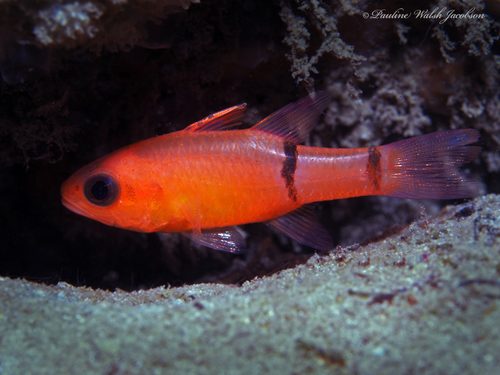
Large examples of Ostorhinchus cyanosoma grow to 8 cm in length although its average length is 6 cm. The fish is colored silver with a blueish tinge, and has six orange-yellow stripes including a short stripe behind the eye.

A new species (Ostorhinchus rubrimacula) was separated out in 1998 from the O. cyanosoma species complex, with almost identical morphology but with a pinkish-red spot on the tail base, and the genetics were confirmed in 2014. Notably, whilst Bleeker noted red fins ('pinnis rubris') in his original sample, he never noted a red tail spot.
Habitat

The most comprehensive recent authority locates O. cyanosoma ranging across the Indo-Pacific, from the Red Sea south to east Africa, east via western Australia and Queensland to New Caledonia, and north to Ryukyu and Ogasawara islands.

Behaviour

O. cyanosoma is mainly a nocturnal planktivore, emerging from hiding in coral caves and crevices to feed by hovering just above sandy microhabitats on coral reef flats. By defecating during the daytime in a non-feeding microhabitat, O. cyanosoma probably helps cycle reef nutrients around different communities on the reef. It appears to prefer to eat small benthic sergestid crustaceans rather than the planktonic larvae to be found higher in the water column. However, seasonal or sampling effects may play a role in defining the diet, since in certain years, certain sites appear to suggest that O. cyanosoma is actually eating significant amounts of planktonic copepods and crustacean larvae.

Reproduction

O. cyanosoma is a paternal mouthbrooder. This is likely to be a more important reason for the sexual dimorphism shown by the male's wider gape and more protruding lower jaw, than is its prey specificity. A bigger mouth allows for more eggs to be protected from predation, and for better water circulation (for oxygenation in both eggs and parent).

Pair bonding in O. cyanosoma does not appear to provide the expected genetic benefits of monogamy, indeed like many pair bonding fishes in its family, predation seems to have driven it rather than reproductive exclusivity.

Humans & conservation

Often stationary and visible low on the reef during the day time, aggregations of O. cyanosoma add to the captivating underwater pallette enjoyed by recreational Scuba divers, whose presence also contributes significantly to local economies in often poorer tropical countries.

Part of

Where to see it

No dive sites list Yellowstriped Cardinalfish yet. Explore the map to find sites near you.