
← All marine life
Yellowfin Tuna
Species IUCN · Least Concern (LC)

Yellowfin Tuna

Thunnus albacares, (Bonnaterre, 1788)

marinebrackish

About Yellowfin Tuna

The yellowfin tuna (Thunnus albacares) is a species of tuna found in pelagic waters of tropical and subtropical oceans worldwide.

Yellowfin is often marketed as ahi, from the Hawaiian ʻahi, a name also used there for the closely related bigeye tuna (Thunnus obesus). The species name, albacares ("white meat") can also lead to confusion: in English, the albacore (Thunnus alalunga) is a different species, while yellowfin is officially designated albacore in French and referred to as albacora by Portuguese fishermen.

Appearance

The yellowfin tuna is among the larger tuna species, reaching weights over 180 kg (400 lb), but is significantly smaller than the Atlantic and Pacific bluefin tunas, which can reach over 450 kg (990 lb), and slightly smaller than the bigeye tuna and the southern bluefin tuna.

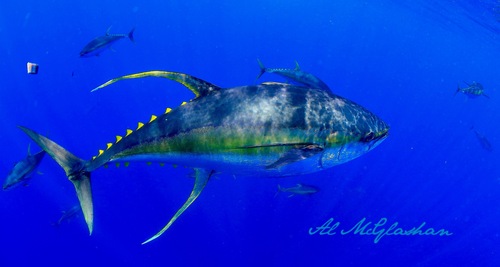
The second dorsal fin and the anal fin, as well as the finlets between those fins and the tail, are bright yellow, giving this fish its common name. The second dorsal and anal fins can be very long in mature specimens, reaching almost as far back as the tail and giving the appearance of sickles or scimitars. The pectoral fins are also longer than the related bluefin tuna, but not as long as those of the albacore. The main body is a very dark metallic blue, changing to silver on the belly, which has about 20 vertical lines.
Habitat

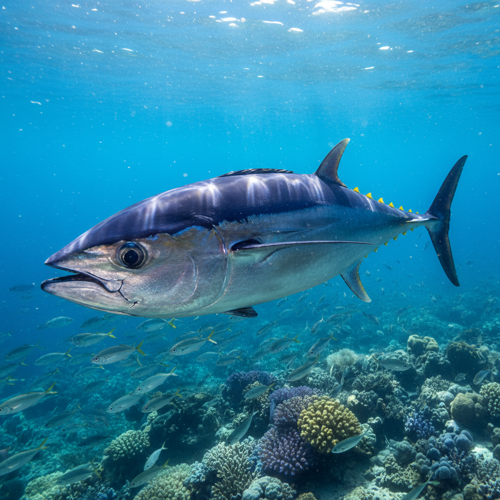
Yellowfin tuna are epipelagic fish that inhabit the mixed surface layer of the ocean above the thermocline. Sonic tracking has found that although yellowfin tuna, unlike the related bigeye tuna, mostly range in the top 100 m (330 ft) of the water column, another study reported that depth tends to vary with time of day: 90% of their recorded depth values were shallower than 88 m (289 ft) during the night, and shallower than 190 m (620 ft) during the day.

Although yellowfin tuna penetrate the thermocline relatively infrequently, they are capable of diving to considerable depths. An individual tagged in the Indian Ocean with an archival tag spent 85% of its time in depths shallower than 75 m (246 ft), but was recorded as having made three dives to 578 m (1,896 ft), 982 m (3,222 ft) and 1,160 m (3,810 ft). The maximum dive depth measured in a second study was 1,592 m (5,223 ft).

Diet

Yellowfin tuna prey include other fish, pelagic crustaceans and squid. Like all tunas, their body shape is particularly adapted for speed, enabling them to pursue and capture fast-moving baitfish such as flying fish, sauries and mackerel. Schooling species such as myctophids or lanternfish and similar pelagic driftfish, anchovies and sardines are frequently taken. Large yellowfins prey on smaller members of the tuna family such as frigate mackerel and skipjack tuna.

Behaviour

Although mainly found in deep offshore waters, yellowfin tuna may approach shore when suitable conditions exist. Mid-ocean islands such as the Hawaiian archipelago, other island groups in the Western Pacific, Caribbean and Red Sea Bab-el-Mandeb in the Indian Ocean, Indonesia, Maldives, as well as the volcanic islands of the Atlantic such as Ascension Island and Saint Helena, often harbor yellowfin feeding on the baitfish these spots concentrate close to the shoreline. Yellowfin may venture well inshore of the continental shelf when water temperature and clarity are suitable and food is abundant.

Humans & conservation

Modern commercial fisheries catch yellowfin tuna with encircling nets (purse seines), and by industrial longlines. In 2010, 558,761 metric tons of yellowfin tuna were caught in the western and central Pacific Ocean.

Part of

Where to see it

No dive sites list Yellowfin Tuna yet. Explore the map to find sites near you.