
← All marine life
Yellowfin Goby
Species IUCN · Least Concern (LC)

Yellowfin Goby

Acanthogobius flavimanus, (Temminck & Schlegel, 1845)

marinebrackishfreshwater

About Yellowfin Goby

Acanthogobius flavimanus, commonly referred to as the yellowfin goby, mahaze, and Japanese river goby, is a goby native to the northwestern Pacific Ocean. It has spread beyond its native range to become an introduced, and often invasive, species. It has been recorded in Australia, Mexico, and Florida and California in the United States.

Appearance

There are variable reports regarding the size of the yellowfin goby. One study, which collected fish near the Kiso River in Japan, found that the yellowfin goby's length ranges from 5-13 centimeters. A species profile conducted by the United States Geological Survey (USGS) describes the fish as being 30 cm long.

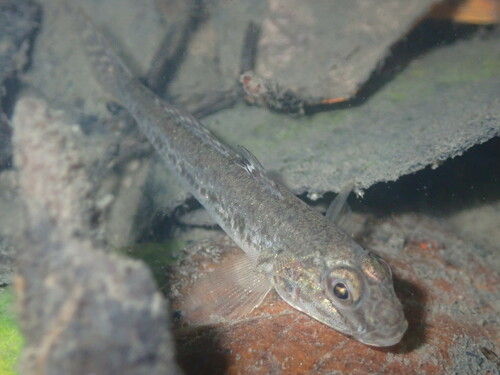
The yellowfin goby has a slender body which is primarily a pale brown color. There are darker brown spots and saddles along the body of the fish, as well as on the dorsal fin. Acanthogobius flavimanus, at all ages, possesses yellow ventral fins. Juveniles also have pale yellow ventral and anal fins (Gomon, 1994). The yellowfin goby has 8 or 9 spines on their first dorsal fin, and 12 to 14 segmented rays on their second fin.

Habitat

Acanthogobius flavimanus is native to northeastern Asia. The fish's native range includes the Bohai Sea, the Yellow Sea, Primorsky Krai, and the Japanese archipelago.

Generally, the yellowfin goby is a bottom dwelling fish, which inhabits bays and estuaries. Juvenile yellowfin gobies prefer tidal sloughs with peatmoss banks and muddy bottoms. Sometimes, outside of spawning seasons, Acanthogobius flavimanus will ascend rivers and streams. Adult fish in freshwater environments will migrate back towards the coast in order to spawn. The yellowfin goby is known to spawn or inhabit a variety of habitats including seawater, freshwater, polyhaline, mesohaline, and oligohaline waters.

Behaviour

The yellowfin goby typically reproduces in tidal mudflats, in both its native and introduced range. Spawning has been recorded at several locations off the coast of California, including the Tomales Bay, San Francisco Bay, San Pablo Bay, and Moss Landing Harbor. Substrates associated with the yellowfin goby's spawning range consist of mud, sand, and hollow bamboo segments.

Humans & conservation

The yellowfin goby has been labeled as a least concern species by the IUCN. The yellowfin goby is considered common in coastal and estuarine waters surrounding Japan, and has even become a popular game fish. In its non-native range, Acanthogobius flavimanus, mainly along the west coast of the United States and the south east coast of Australia, the fish is well established. Along with other goby species in the San Francisco estuary, the yellowfin goby is used as baitfish.

Currently, there are no known diseases which pose a threat to the yellowfin goby. However, a multitude of parasitoids have been found inside of Acanthogobius flavimanus. The first was found living in the brain of the fish in 1952, it was named Myxobolus acanthogobii. Since then, more than a dozen parasites have been found living within the yellowfin goby.

Where to see it

No dive sites list Yellowfin Goby yet. Explore the map to find sites near you.