
← All marine life
Yellow and Blueback Fusilier
Species IUCN · Least Concern (LC)

Yellow and Blueback Fusilier

Caesio teres, Seale, 1906

marine

About Yellow and Blueback Fusilier

Caesio teres, the yellow and blueback fusilier, beautiful fusilier, blue and gold fusilier (not to be confused with Caesio caerulaurea) or yellow-tail fusilier, is a species of marine, pelagic ray-finned fish belonging to the family Caesionidae. It occurs in the Indian and Western Pacific Oceans.

Appearance

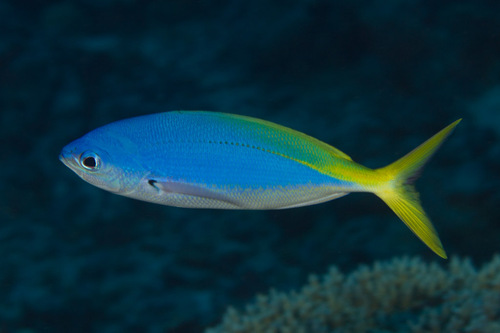
Caesio teres has a moderately deep, fusiform and laterally compressed body. The dorsal fin has 10 spines and 14–16, typically 15, soft rays while the anal fin contains 3 spines and 12–13 soft rays. The pectoral fins contain 20–22, typically 21 rays. This species attains a maximum total length of 40 cm (16 in), although 26.6 cm (10.5 in) is more typical. The upper back and the rear part of the dorsal fin are bright yellow with the remainder of the body being bright blue on the upper body and white ventrally. The pectoral fin is white with a black upper base, the pelvic and anal fins are white.

Habitat

Caesio teres has a wide tropical Indo-West Pacific distribution. It is found from the East African coast between Somalia and South Africa east into the Pacific as far as the Line and Tuamotu Islands, north to southern Japan south to the Great Barrier Reef. It is absent from the Red Sea and the Persian Gulf. In Australian waters this species is found at Rowley Shoals in Western Australia, at the Ashmore Reef in the Timor Sea, and from the northern Great Barrier Reef to Escape Reef, Queensland. It is also found at Christmas Island and the Cocos (Keeling) Islands. This species is found on coral reefs at depths between 5 and 60 m (16 and 197 ft).

Humans & conservation

Caesio teres is targeted by fisheries in some parts of its distribution and frequently drive-in nets are used to catch it.

Part of

Where to see it

No dive sites list Yellow and Blueback Fusilier yet. Explore the map to find sites near you.