
← All marine life
Worm
Group

Worm

Annelida, Lamarck, 1802 [as Annelides]

marinebrackishfreshwater

About Worm

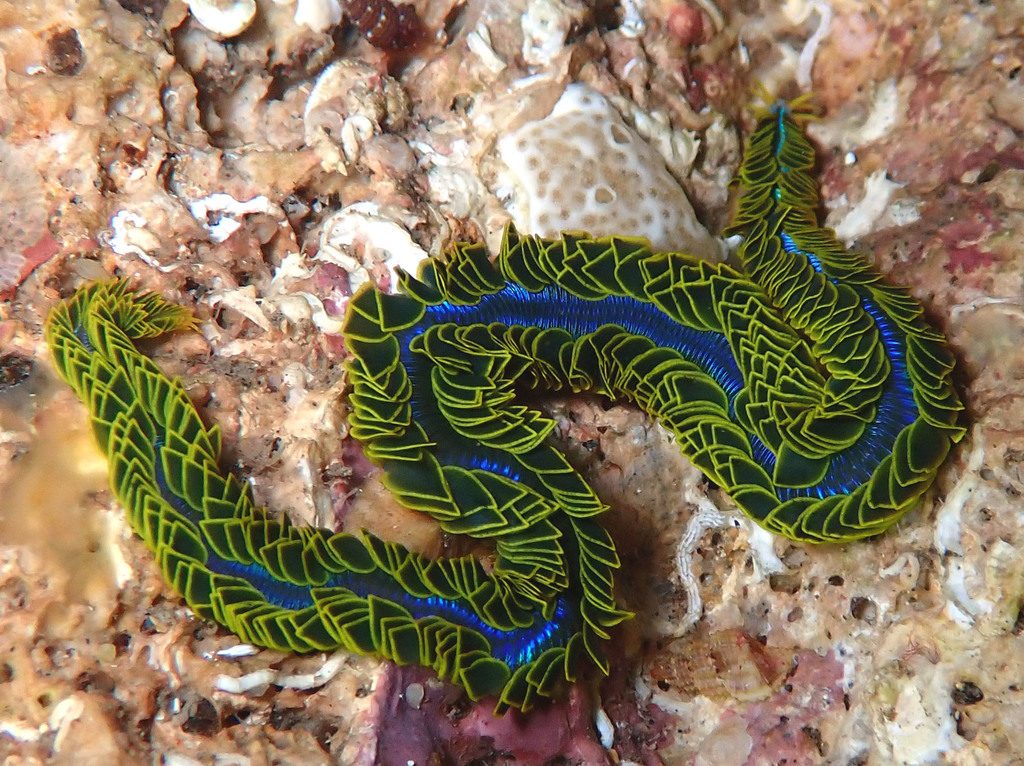
Annelids, also known as segmented worms, are animals that comprise the phylum Annelida (; from Latin anellus 'little ring'). The phylum contains over 22,000 extant species, including ragworms, earthworms, and leeches. The species exist in and have adapted to various ecologies – some in marine environments as distinct as tidal zones and hydrothermal vents, others in fresh water, and yet others in moist terrestrial environments.

Annelids are bilaterally symmetrical, triploblastic, coelomate, invertebrate organisms. They also have parapodia for locomotion. Most textbooks still use the traditional division into Polychaetes (almost all marine), Oligochaetes (which include earthworms) and Hirudinea (leech-like species). Cladistic research since 1997 has radically changed this scheme, viewing leeches as a sub-group of oligochaetes and oligochaetes as a sub-group of polychaetes. In addition, the Pogonophora, Echiura and Sipuncula, previously regarded as separate phyla, are now regarded as sub-groups of polychaetes. Annelids are considered members of the Lophotrochozoa, a "super-phylum" of protostomes that also includes molluscs, brachiopods, and nemerteans.

Appearance

In addition to Sipuncula and Echiura, also lineages like Lobatocerebrum, Diurodrilus and Polygordius have lost their segmentation, but these are the exceptions from the rule. Most of an annelid's body consists of segments that are practically identical, having the same sets of internal organs and external chaetae (Greek χαιτη, meaning "hair") and, in some species, appendages. The frontmost and rearmost sections are not regarded as true segments as they do not contain the standard sets of organs and do not develop in the same way as the true segments. The frontmost section, called the prostomium (Greek προ- meaning "in front of" and στομα meaning "mouth") contains the brain and sense organs, while the rearmost, called the pygidium (Greek πυγιδιον, meaning "little tail") or periproct contains the anus, generally on the underside.

Diet

Feeding structures in the mouth region vary widely, and have little correlation with the animals' diets. Many polychaetes have a muscular pharynx that can be everted (turned inside out to extend it). In these animals the foremost few segments often lack septa so that, when the muscles in these segments contract, the sharp increase in fluid pressure from all these segments everts the pharynx very quickly. Two families, the Eunicidae and Phyllodocidae, have evolved jaws, which can be used for seizing prey, biting off pieces of vegetation, or grasping dead and decaying matter. On the other hand, some predatory polychaetes have neither jaws nor eversible pharynges. Selective deposit feeders generally live in tubes on the sea-floor and use palps to find food particles in the sediment and then wipe them into their mouths.

Reproduction

Polychaetes can reproduce asexually, by dividing into two or more pieces or by budding off a new individual while the parent remains a complete organism. Some oligochaetes, such as Aulophorus furcatus, seem to reproduce entirely asexually, while others reproduce asexually in summer and sexually in autumn. Asexual reproduction in oligochaetes is always by dividing into two or more pieces, rather than by budding. However, leeches have never been seen reproducing asexually.

Most polychaetes and oligochaetes also use similar mechanisms to regenerate after suffering damage. Two polychaete genera, Chaetopterus and Dodecaceria, can regenerate from a single segment, and others can regenerate even if their heads are removed. Annelids are the most complex animals that can regenerate after such severe damage. On the other hand, leeches cannot regenerate.

Humans & conservation

Earthworms make a significant contribution to soil fertility. The rear end of the Palolo worm, a marine polychaete that tunnels through coral, detaches in order to spawn at the surface, and the people of Samoa regard these spawning modules as a delicacy. Anglers sometimes find that worms are more effective bait than artificial flies, and worms can be kept for several days in a tin lined with damp moss. Ragworms are commercially important as bait and as food sources for aquaculture, and there have been proposals to farm them in order to reduce over-fishing of their natural populations. Some marine polychaetes' predation on molluscs causes serious losses to fishery and aquaculture operations.

Scientists study aquatic annelids to monitor the oxygen content, salinity and pollution levels in fresh and marine water.

Where to see it

No dive sites list Worm yet. Explore the map to find sites near you.