
← All marine life
Wonderpus Octopus
Species IUCN · Least Concern (LC)

Wonderpus Octopus

Wunderpus photogenicus, Hochberg, M. Norman & Finn, 2006

marine

About Wonderpus Octopus

Wunderpus photogenicus, the wunderpus octopus, is a small-bodied species of octopus with distinct white and rusty brown coloration. 'Wunderpus' from German "wunder" meaning 'marvel' or 'wonder'.

Due to the appearance and behavior of the wunderpus, it is frequently confused with its close relative, the mimic octopus. The wunderpus octopus was not discovered until the 1980s and was only officially described in detail in 2006. The wunderpus octopus is important commercially to the underwater photography, dive and tourism communities, especially throughout Indonesia. The wunderpus is also valued as an expensive ornamental marine species for the home aquarium.

Appearance

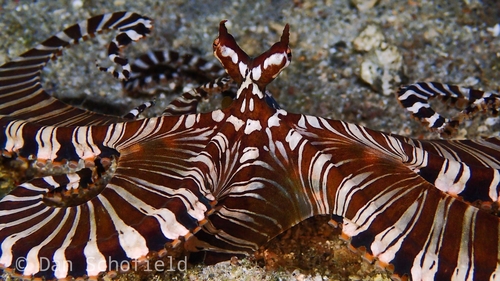
An adult wunderpus octopus displays an individually unique pattern of white spots and bands over a rusty brown background. Even though each body pattern is unique to the individual, generally all wunderpus octopuses display a circular pattern of about six white spots at the posterior lip of its mantle, head and neck area. Some of these spots are fused.

As the wunderpus ages, their body patterns become more complex. Each body is consistently covered in a brownish-red coloration, both dorsally and ventrally, with white lateral bands and markings along their arms, mantle, head and eye stalks. Underneath, their suckers are a yellowish-cream color. The wunderpus has relatively smooth skin with papillae throughout body.
Habitat

The wunderpus is found in shallow waters from Bali and Sulawesi north to the Philippines and east to Vanuatu. A popular spot for the wunderpus, documented by dive photographers, is in the volcanic sand plain near the Lembeh Strait. These soft-bodied octopuses are benthic creatures, living along the bottom sediments in relatively shallow waters (no deeper than 20 m or 66 ft). The wunderpus prefers a habitat with soft sediment substrates that allows them to burrow under the substrate or other organisms to seek shelter. Populations of the wunderpus can vary and be as dense as up to 5 individuals per 25 m2 (270 ft2) or as little as not even being able to be spotted.

Diet

The wunderpus feed from dusk to dawn on small crustaceans and fishes. They have two prime feeding strategies. The first method is the "probing" method, where the wunderpus will extend their arms to crevices and holes to look for prey. When prey is encountered, they use their arms and suckers to hold onto the prey and remove it from its burrow. The second method of feeding requires them to flare their arms and webs over coral and sand to trap their prey and this method is called "web-casting". When the wunderpus does this, it almost looks like an opened umbrella.

Behaviour

Little is actually known and documented about the behavior and life history of the wunderpus and this could partially be due to their life style choice of solitude. There is little to no social behavior exhibited in the wunderpus octopus. Of the few specific postures and behavioral patterns that have been observed of the wunderpus, it is believed that they are impersonators of other animals. There are studies that suggest that the wunderpus is known to impersonate animals like the lionfish and the banded sea krait. The banded white markings of the wunderpus, allow it to be able to mimic the stripes and spines of the lionfish. It has also been documented that the wunderpus will burrow six of their arms, leaving two free to mimic the appearance of the banded sea krait.

Reproduction

In male wunderpus, their reproductive organ (penis) is relatively short but strong. They have a spermatophore storage sac located sub-terminally in the mantle, that takes up about 50% of the mantle's length. This storage sac is broad and translucent allowing the spermatophores to be seen through the thin sac wall. The spermatophores are 'unarmed' and are usually in counts of 25–30 in these translucent storage sacs.

The female wunderpus has a large sub-terminal ovary with 4 follicular folds. The female will produce around 2,000 mature small, stalked eggs within a single female brood. The female will carry her eggs in her arms and they typically die shortly after their offspring hatch. Wunderpus hatchlings become water column swimmers and move around with their tiny finger-like arms rather than benthic organisms.

Part of

Where to see it

No dive sites list Wonderpus Octopus yet. Explore the map to find sites near you.