
← All marine life
Wolf Eel
Species IUCN · Least Concern (LC)

Wolf Eel

Anarrhichthys ocellatus, Ayres, 1855

marine

About Wolf Eel

The wolf eel (Anarrhichthys ocellatus) is a species of marine ray-finned fish belonging to the family Anarhichadidae, the wolf fish. It is found in the North Pacific Ocean. Despite its common name and resemblance, it is not a true eel. It is the only species in the monotypic genus Anarrhichthys.

Appearance

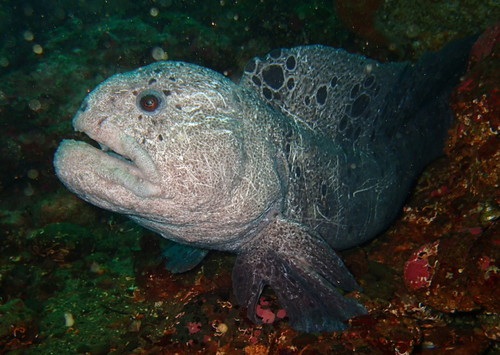
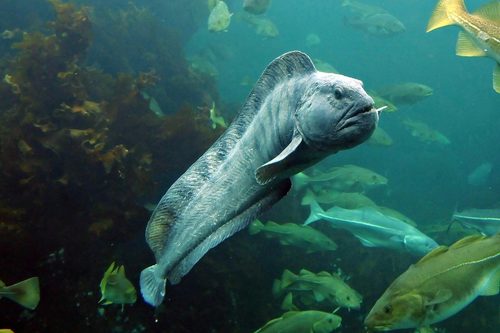
A. ocellatus differs from true eels, as they have paired gill slits and pectoral fins. The animal can grow up to 2.4 m (7 ft 10 in) in length and 18.4 kg (41 lb) in weight.

Younger wolf eels are orange with big dark spots in the posterior part of the body. Once older they turn grey, brown greyish or dark olive.

They possess powerful jaws with which they crush their prey: canine teeth in the front and molars in the posterior portion of the mouth. In the anal fin, it has no rays and 233 radials. It only has one dorsal fin, that extends from the head to the end of the body, with 228 to 250 flexible fishbones without soft radius. The caudal fin is small. It has no pelvic fins, nor a lateral line.

Males have large lips and a protuberance on the superior part of the head. The lifespan of this species is about 20 years.
Diet

This eel-like fish feeds on invertebrates with hard shells (crustaceans, sea urchins, mussels, clams) and some fishes, crushing them with its strong jaws. It has been observed in captivity that when they are fed soft food such as squid, they tend to prefer it over hard food, which can damage the back teeth.

Behaviour

A. ocellatus is found in caves, crevices and rocky reefs from shallow waters to a depth of 226 m (741 ft), ranging from the Sea of Japan and the Bering Sea to Northern California.

Reproduction

Wolf eels have a monogamous relationship and tend to mate for life and live in the same cave. They reproduce from October until the end of winter, beginning when they are around seven years old. The male places his head against the female's abdomen and wraps around her, while she extrudes the eggs, up to 10,000 at a time, which he then fertilizes. She coils around the eggs, using her body to shape the eggs into a neat sphere, roughly the size of a grapefruit. The male then coils around her. Together they protect the eggs, and only one leaves the cave at a time, to feed. The eggs hatch after 91 to 112 days, and during this period, in order to ensure their oxygenation, the female circulates water around the eggs and periodically massages and rotates the eggs as they develop.

Part of

Where to see it

No dive sites list Wolf Eel yet. Explore the map to find sites near you.