
← All marine life
Witch Flounder
Species IUCN · Vulnerable (VU)

Witch Flounder

Glyptocephalus cynoglossus, (Linnaeus, 1758)

marine

About Witch Flounder

The witch (Glyptocephalus cynoglossus), known in English by a variety of other common names including the witch flounder, pole flounder, craig fluke, Torbay sole, and grey sole, is a species of flatfish from the family Pleuronectidae. It occurs on both sides of the North Atlantic Ocean on muddy sea beds in quite deep water. In northern Europe it has some importance in fisheries as a food fish.

Appearance

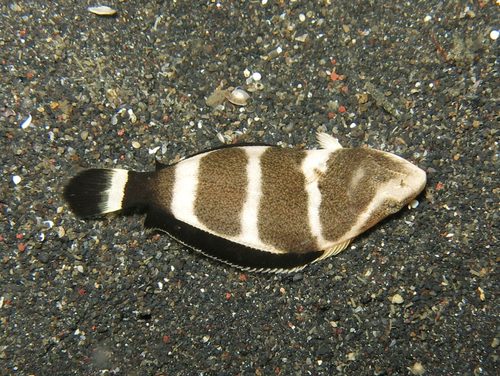
The witch is a right-eyed flatfish with a small mouth which reaches the forward edge of the lower eye. The mouth contains a single series of small, incisor like teeth. It has a small head which takes up a fifth of the total length with large, open blister-like mucous pits on its blind side Its body is strongly, dorsally compressed and oval in shape. The body is elongated and has a standard length which is 2.5–3.5 times longer than it is broad. The lateral line is relatively straight and runs the length of its body with 110–140 scales. The dorsal fin has 95–120 rays and the anal fin has 85–102 rays, and there is a short, sharp spine pointing forward in front of the anal fin, which is created by an elongated first interhaemal spine of the post-abdominal bone, although this is sometimes so small that it is hidden.
Habitat

The witch occurs on both sides of the North Atlantic Ocean. In the northeastern Atlantic Ocean it is found from the northernmost part of the Bay of Biscay to the Kattegat and into the westernmost part of the Baltic Sea, northwards along the entire coast of Norway and east in to the Murmansk region of Russia and west to the southern and western coasts of Iceland. In the western North Atlantic their range runs from Newfoundland and Labrador south as far as North Carolina, including the Grand Banks, Gulf of Maine, Gulf of St Lawrence and the Scotian Shelf.

Humans & conservation

The witch is commercially important as a bycatch and there are fisheries directed at this species, except that it is occasionally targeted in the Skagerrak. It is an important bycatch species in some fisheries which target the langoustine (Nephrops norvegicus). There was a notable increase in the landings of this species in the 1980s as a result of increased fishing effort by Iceland, Spain, and Norway. The North Sea is where most of the commercial landings in the northeast Atlantic are made and this species is rarely landed in Norway. The FAO reported a total catch for G. cynoglossus in 1999 of 18,969 tonnes, while more recent statistics are that approximately 13,600 tonnes are taken by European fisheries annually with United Kingdom vessels taking around 3,600 tonnes of this total catch. In North America commercial fisheries take around 2,700 tonnes annually.

Part of

Where to see it

No dive sites list Witch Flounder yet. Explore the map to find sites near you.