
← All marine life
Winter Flounder
Species IUCN · Vulnerable (VU)

Winter Flounder

Pseudopleuronectes americanus, (Walbaum, 1792)

marine

About Winter Flounder

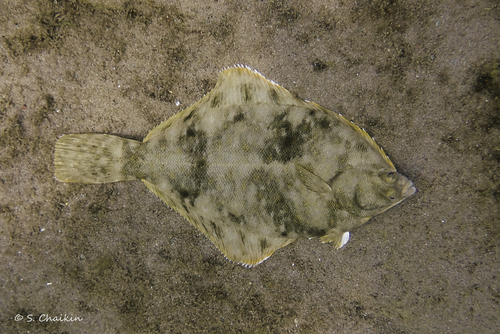
The winter flounder (Pseudopleuronectes americanus), also known as the black back, is a right-eyed ("dextral") flatfish of the family Pleuronectidae. It is native to coastal waters of the western north Atlantic coast, from Labrador, Canada to Georgia, United States, although it is less common south of Delaware Bay. It is the most common near-shore (shallow-water) flounder in the waters from Newfoundland down through Massachusetts Bay, reaching a maximum size around 61 cm in length and 2.25 kg in weight. The species grows larger on Georges Bank, where they can reach a length of 70 cm and weight of 3.6 kg. Although winter flounder historically supported large commercial and recreational fisheries, biomass and landings have decreased since the 1980s.

Diet

Larval winter flounder are known to feed on nauplii, harpacticoids, calanoids, polychaetes, invertebrate eggs, and phytoplankton. As they grow, copepods, amphipods, and polychaetes all become more important elements of their diet. Adult winter flounder are opportunistic sight-feeders that target annelids, crustaceans, bivalves, and fish depending upon prey availability.
Reproduction

Winter flounder lay up to 3.3 million demersal, adhesive eggs that are retained within their spawning grounds. Depending on temperature, larvae of approximately 3 mm in length hatch in two to three weeks. These larvae are planktonic at first, but transition to a bottom-oriented lifestyle over time. Around five to six weeks after hatching, the left eye of the larval flounder begins to migrate to the right side of the body. The "flounder-like" juveniles then settle onto the seafloor and move into saltwater coves, coastal salt ponds, estuaries, and protected bays, where they may grow up to 100 mm within the first year. Adult winter flounder may grow as large as 70 cm and reach ages of 15+ years. Growth varies across their distribution, with northern populations generally growing slower than those at the southern end of their range.

Humans & conservation

Winter flounder are highly regarded for their delicious white meat and are sometimes called lemon sole in the U.S. They once supported large commercial and recreational fisheries, with peak harvests of 40.3 million pounds and 16.4 million pounds respectively. However, landings in both sectors have declined since the 1980s to 6 million pounds and 77,000 pounds respectively in 2013.

Part of

Where to see it

No dive sites list Winter Flounder yet. Explore the map to find sites near you.