
← All marine life
Whitetip Reef Shark
Species IUCN · Vulnerable (VU)

Whitetip Reef Shark

Triaenodon obesus, (Rüppell, 1837)

marine

About Whitetip Reef Shark

The whitetip reef shark (Triaenodon obesus) is a species of requiem shark, in the family Carcharhinidae. It is the only extant species of genus Triaenodon. A small shark that does not usually exceed 1.6 m (5.2 ft) in length, this species is easily recognizable by its slender body and short but broad head, as well as tubular skin flaps beside the nostrils, oval eyes with vertical pupils, and white-tipped dorsal and caudal fins. One of the most common sharks found on Indo-Pacific coral reefs, the whitetip reef shark occurs as far west as South Africa and as far east as Central America. It is typically found on or near the bottom in clear water, at a depth of 8–40 m (26–131 ft).

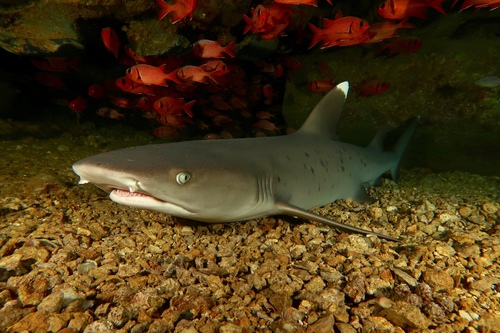
During the day, whitetip reef sharks spend much of their time resting inside caves. Unlike other requiem sharks, which rely on ram ventilation and must constantly swim to breathe, this shark can pump water over its gills and lie still on the bottom. At night, whitetip reef sharks emerge to hunt bony fishes, crustaceans, and octopus in groups, their elongate bodies allowing them to force their way into crevices and holes to extract hidden prey. Individuals may stay within a particular area of the reef for months or years, frequently returning to the same shelter. This species is viviparous, in which the developing embryos are sustained by a placental connection to their mother.

Appearance

A relatively small species, few whitetip reef sharks are longer than 1.6 m (5.2 ft). The maximum length this species attains is often given as 2.1 m (6.9 ft), though this was originally based on visual observations and may be dubious. The maximum reported weight is 18.3 kg (40 lb). The whitetip reef shark has a slim body and a short, broad head. The snout is flattened and blunt, with large flaps of skin in front of the nares that are furled into tubes. The eyes are small and oval with vertical pupils and prominent ridges above, and are often followed by a small notch. The mouth has a distinct downward slant (imparting a disgruntled expression to the shark), with short furrows at the corners. There are 42–50 tooth rows in the upper jaw and 42–48 tooth rows in the lower jaw. Each tooth has a single narrow, smooth-edged cusp at the center, flanked by a pair of much smaller cusplets.
Habitat

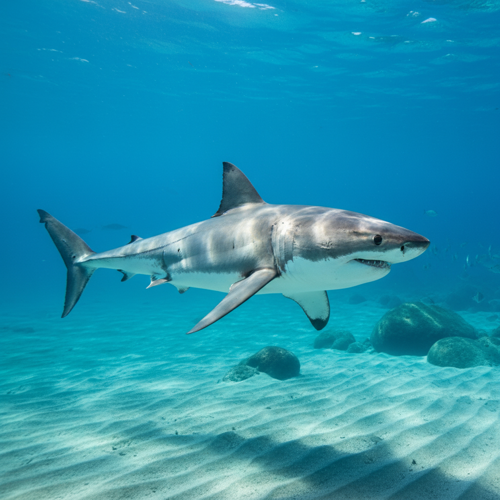
The whitetip reef shark is distributed widely across the entire Indo-Pacific region. It was once thought to have existed in the Atlantic Ocean, based on fossil teeth found in North Carolina dated to the Miocene epoch, although subsequent research has suggested that the teeth are of a mackerel shark, and that the whitetip has never colonized the Atlantic. In the Indian Ocean, whitetip reef sharks can be found off of northern KwaZulu-Natal, South Africa and all along the East African coast, from the Horn of Africa to the Red Sea and along the Indian subcontinent (including Sri Lanka). They are found near many major island chains as well, including Madagascar, Mauritius, Mayotte, the Comoros, the Aldabra Group, the Seychelles and the Chagos Archipelago.

Diet

With its slender, lithe body, the whitetip reef shark specializes in wriggling into narrow crevices and holes in the reef and extracting prey inaccessible to other reef sharks. Alternatively, it is rather clumsy when attempting to take food suspended in open water. This species feeds mainly on bony fishes, including eels, squirrelfishes, snappers, damselfishes, parrotfishes, surgeonfishes, triggerfishes and goatfishes, as well as octopuses, spiny lobsters, and crabs. The whitetip reef shark is highly responsive to the olfactory, acoustic, and electrical cues given off by potential prey, while its visual system is attuned more to movement and/or contrast than to object details. It is especially sensitive to natural and artificial low-frequency sounds in the 25–100 Hz range, which evoke struggling fish.

Behaviour

The whitetip reef shark is one of the three most common sharks inhabiting the reefs of the Indo-Pacific, the other two being the blacktip reef shark (Carcharhinus melanopterus) and the grey reef shark (Carcharhinus amblyrhynchos). The habitat preferences of this species overlap those of the other two, though it does not tend to frequent very shallow water like the blacktip reef shark, nor the outer reef like the grey reef shark. The whitetip reef shark swims with strong undulations of its body, and unlike other requiem sharks can lie motionless on the bottom and actively pump water over its gills for respiration. This species is most active at night or during slack tide, and spends much of the day resting inside caves singly or in small groups, arranged in parallel or stacked atop one another.

Reproduction

Mating is initiated when up to five males follow closely behind a female and bite at her fins and body, possibly cued by pheromones indicating the female's readiness. Each male attempts to seize the female by engulfing one of her pectoral fins; at times two males might grasp a female on both sides simultaneously. Once engaged, the sharks sink to the bottom, whereupon the male (or males) rotates one of his claspers forward, inflates the associated siphon sac (a subcutaneous abdominal organ that takes in seawater that is used to flush sperm into the female), and attempts to make contact with the female's vent. In many cases, the female resists by pressing her belly against the bottom and arching her tail; this may reflect mate choice on her part.

Humans & conservation

The white tip reef shark is more harmless and is seldom aggressive unless provoked. They are also fearless and curious, as the whitetip reef sharks may approach swimmers closely to investigate. However, these sharks readily attempt, and quite boldly, to steal catches from spear fishers, which has resulted in several people being bitten in the process. In some places, local whitetip reef sharks have learned to associate the sound of a speargun discharge or a boat dropping anchor with food and respond within seconds. As of 2008, the International Shark Attack File lists two provoked and three unprovoked attacks to this species. Whitetip reef sharks are well-suited to ecotourism diving, and with conditioning they can be hand-fed by divers.

Part of

Where to see it

No dive sites list Whitetip Reef Shark yet. Explore the map to find sites near you.