
← All marine life
Whitespotted Anglerfish
Species

Whitespotted Anglerfish

Phyllophryne scortea, (McCulloch & Waite, 1918)

marine

About Whitespotted Anglerfish

Phyllophryne is a monospecific genus of marine ray-finned fish belonging to the subfamily Histiophryninae in the family Antennariidae, the frogfishes. The only species in the genus is Phyllophryne scortea, the white-spotted anglerfish, smooth anglerfish or smooth frogfish, which is endemic to southern Australia.

Appearance

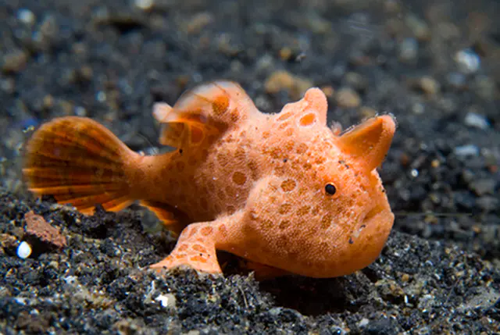
Phyllophryne has the second and third dorsal spines are not hidden underneath the skin. The seven inner rays of the caudal fin are forked while the outer rays are simple. The skin is smooth with no dermal denticles and there is no caudal peduncle. The rear margins of the dorsal and anal fins is not connected to the outer rays of the caudal fin by a membrane. The skin has scattered fleshy appendages. The illicium, the fishing rod, has an oval esca or lure with a number of filaments at its tip. This fish varies in colour from green, yellow, orange, brown to dark grey or black, frequently with whitish mottles or spots. The dorsal fin is supported bybetween 7 and 9 soft rays. 15 or 16 soft rays while the anal fin contains The white-spotted anglerfish has a maximum published total length of 10 cm (3.9 in).
Habitat

Phyllophryne is endemic to southern Australia. It is distributed from Green Cape, New South Wales and Tasmania west to the Houtman Abrolhos off Western Australia. This is a benthic fish is found in temperate waters at depths down to 44 m (144 ft) on rocky reefs in bays, estuaries and coastal environments, frequently hiding under rocks and among sponges.

Part of

Where to see it

No dive sites list Whitespotted Anglerfish yet. Explore the map to find sites near you.