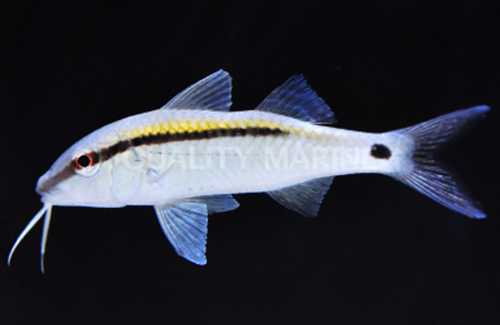
Appearance
Parupeneus porphyreus has pale streaks along the body. They can be grayish purple, greenish, or reddish in color and have a remarkable ability to change color in seconds. They have a small white spot, or saddle above the base of the tail and beard-like extrusions called barbels on the lower part of its head, resembling a goats beard.
Kolokolopā or mākolokolopā is the tiny stage of the kūmū. ʻAhuluhulu is the name of a juvenile kūmū. Kūmū aʻe is the stage when young kūmū are in the process of transforming into an adult kūmū. Kūmū is the term for adults.
As adults are crepuscular or nocturnal, but young feed during the day, so adults seek. They shelter in the holes of the reef during the day and forage over sand during the night to find food. In contrast, juveniles feed during the day.