
← All marine life
White Sturgeon
Species IUCN · Least Concern (LC)

White Sturgeon

Acipenser transmontanus, Richardson, 1836

marinebrackishfreshwater

About White Sturgeon

White sturgeon (Sinosturio transmontanus) is a species of sturgeon in the family Acipenseridae of the order Acipenseriformes. They are an anadromous (migratory) fish species ranging in the Eastern Pacific; from the Gulf of Alaska to Monterey, California. However, some are landlocked in British Columbia, the Fraser River and Columbia River, Montana, Snake River, and Clearwater River in Idaho, and Lake Shasta in California, with reported sightings in northern Baja California, Mexico.

Appearance

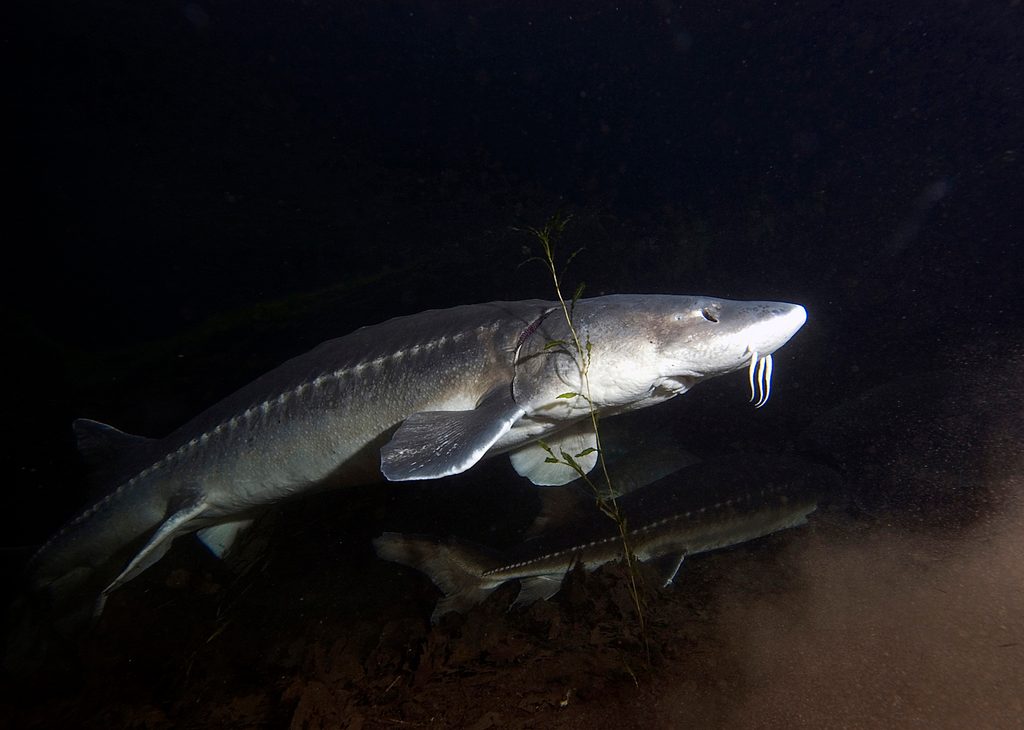
S. transmontanus is distinguished by the two rows of four to eight ganoid bony plates between the anus and anal fin, with about 45 rays present in the dorsal fin. Coloring can range from gray to brownish on the dorsal side, paler on the ventral side, and gray fins. Barbels are situated anterior to the mouth, closer to the snout than the mouth.

Habitat

White sturgeon are native to several large North American rivers that drain to the Pacific Ocean. They primarily live in estuaries of large rivers, but migrate to spawn in freshwater, and travel long distances between river systems. Reproducing populations have been documented along the West Coast, from northern Mexico up to the Aleutian Islands in Alaska. White sturgeon are commonly found in deep, soft bottomed areas of estuaries, where movements in the water column is dependent on salinity.

Historical ranges have been modified substantially by overharvesting, habitat changes due to dams, and river regulations; all affecting habitat quality, suitability and connectivity.

Diet

Larval white sturgeon 10–11 mm (0.39–0.43 in) in TL experience the highest mortality when they transition from endogenous to exogenous feeding, around 8–14 days post-hatch depending on conditions. Once larvae metamorphose into young of the year (YOY) and juveniles, they actively feed on the substrate, dominantly Corophium spp., relying on water currents to carry them downriver to areas of suitable food. The availability of Corophium spp. could play a key role in the survival of larval and YOY white sturgeon in the Columbia River and could possibly explain the apparent poor survival of larvae and YOY in some Snake and Columbia River reservoirs that apparently have successful spawning but poor recruitment.

Reproduction

"White sturgeons are iteroparous breeders with a spawning period in the Sacramento and San Joaquin Rivers between mid-February to late May, with peak activity during March and April" - Kohlhorst 1976.

There is much uncertainty around reproduction timing of events in white sturgeon, with many papers reporting differing results dependent on the river system observed. Chapman, Van Enennaam and Doroshov witnessed sexually mature females 950 mm (3.12 ft) FL in the Sacramento-San Joaquin River system estimated around nine years old by using the Von Bertalanffy growth function, while the youngest sexual mature was a male 750 mm (2.46 ft) FL estimated to be six years old. However, other reports have sexual maturity for white sturgeon at twelve years old for females and ten years old for males. Uncertainty around age estimates from fin ray annulus may account for any disparity.

Humans & conservation

White sturgeon are a resource to a variety of different social and economic groups around the world. Aquaculture facilities cultivate white sturgeon in California and juveniles can be sold to aquarists. They were once the main food source for Native Americans in the 1800s, until overfishing by commercial fleets for caviar drove them to near extinction by the early 1900s. Besides their meat, other important economic products associated with caught sturgeon are caviar, isinglass, and oil. While selling a wild white sturgeon and eggs is illegal in California, it is legal to buy legal caviar from California White sturgeon farms. Poaching is an ongoing issue, in which caviar can sell on the black market for US$100–150 per pound, while a consumer buying legally made caviar from California sturgeon farms pays anywhere from US$40 to $700 for an ounce.

Where to see it

No dive sites list White Sturgeon yet. Explore the map to find sites near you.